A standard aluminum window frame conducts heat roughly 400 times faster than wood and dramatically faster than vinyl — a fact that explains almost everything about why thermally broken aluminum exists in the first place. For Indian homeowners choosing between the two, the decision often gets reduced to price alone, but that misses the actual engineering difference between them, which matters a great deal in a country where summer temperatures in Delhi, Nagpur, or Ahmedabad regularly push past 43°C. Understanding what “thermally broken” actually means, and where it genuinely earns its higher cost, makes this a far easier decision than most window showrooms make it sound.
What “Thermally Broken” Actually Means
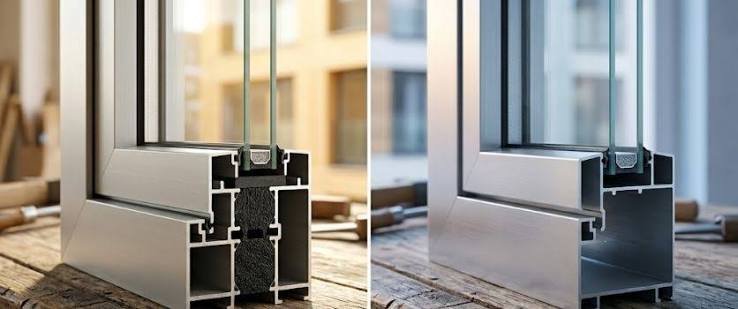
Standard aluminum window frames are a single continuous piece of metal running from the outside face to the inside face. Because aluminum is such an efficient heat conductor, that continuous metal path acts almost like a highway for outdoor heat to enter the home — or for indoor cooling to leak out.
A thermally broken frame interrupts that path with a strip of low-conductivity material, usually polyamide or polyurethane, physically separating the outer and inner aluminum sections while keeping them structurally joined.
- The insulating strip blocks direct metal-to-metal heat transfer across the frame.
- The frame still retains aluminum’s strength and slim profile, since only a narrow section is replaced with the insulating material.
- This construction is sometimes called a “thermal barrier” system in Indian dealer catalogs, which is the same technology under a different name.
The result is a frame that looks nearly identical to standard aluminum from a few feet away but behaves very differently in terms of heat and cold transfer.
Energy Efficiency: Where the Real Difference Shows Up
This is the category thermally broken systems exist to solve, and the difference is measurable rather than marketing language.
- Standard aluminum frames transfer heat rapidly in both directions, meaning rooms with these windows absorb outdoor heat quickly in summer and lose indoor warmth quickly in winter.
- Thermally broken frames slow this transfer significantly, keeping interior surface temperatures near the window closer to room temperature rather than mirroring the outdoor extreme.
- The difference is most noticeable in rooms with large glazed areas — floor-to-ceiling windows, balcony sliders, and corner windows common in newer Indian apartment designs.
- In peak summer, touching the interior frame of a standard aluminum window often reveals it’s noticeably warmer than the surrounding wall; a thermally broken frame stays closer to ambient room temperature.
For homes relying heavily on air conditioning, this translates into a real, if gradual, reduction in cooling load — though the exact savings depend on window size, orientation, and how much of the exterior wall is glazed.
Condensation and Moisture: An Underrated Difference
Indian homeowners rarely factor condensation into the decision, but it’s one of the more practical everyday differences between the two systems.
- Standard aluminum frames, being highly conductive, often reach dew point temperature on their interior surface during humid mornings or the early monsoon transition, causing visible condensation on the frame itself.
- This moisture, left unaddressed, can lead to mold growth on nearby walls, curtains, or wooden furniture placed close to the window.
- Thermally broken frames stay warmer on the interior side relative to outdoor conditions, which reduces the likelihood of hitting dew point and forming condensation.
- Coastal and high-humidity cities — Mumbai, Kochi, Chennai — tend to see this issue more often than drier northern cities, making it a relevant factor for buyers in those regions specifically.
This is a maintenance and health consideration as much as a comfort one, and it’s often overlooked until a homeowner notices recurring dampness around older aluminum frames.
Cost Comparison: What the Premium Actually Buys
The price gap between the two systems is real and worth being upfront about.
- Thermally broken aluminum windows typically cost noticeably more than standard aluminum, largely due to the more complex extrusion process and the insulating strip material itself.
- The gap narrows somewhat when both are paired with double-glazed glass, since glass cost becomes a larger share of the total price either way.
- Installation costs are similar between the two, since the fabrication and fitting process doesn’t differ dramatically.
- The cost difference is best judged over the ownership period rather than at purchase — lower cooling bills over 10-15 years can offset a meaningful portion of the upfront premium, particularly in hot regions with heavy AC use.
For budget-sensitive projects, this is usually where the decision gets made — not on performance alone, but on whether the long-term savings justify the immediate cost difference.
Structural Strength and Design Flexibility
- Both systems offer comparable structural strength for most residential applications, since the thermal break doesn’t meaningfully compromise the frame’s load-bearing capacity in standard window sizes.
- Standard aluminum retains a very slight edge for extremely large spans or heavy glazing, simply because it has one less interface point in the frame’s structure.
- Both are available in similar slim-profile aesthetics, so there’s little visual compromise in choosing the thermally broken version.
- Color and finish options are largely identical between the two, since both use powder coating or anodizing as the final finish.
In practice, this category rarely tips the decision one way or the other for typical residential window sizes.
Which Option Suits Which Climate and Home Type
A few patterns are worth considering based on where the home is located and how it’s used.
- Hot, dry regions (Rajasthan, Delhi NCR, central India): Thermally broken aluminum offers a meaningful reduction in heat gain during long, intense summers, making the premium easier to justify.
- Coastal, humid cities (Mumbai, Chennai, Kochi): Both the energy and condensation benefits of thermal breaks are relevant here, alongside the usual need for strong corrosion-resistant coating.
- Moderate climate zones (Bengaluru, Pune): Standard aluminum often performs adequately, and the premium for thermal breaks may not deliver proportional value unless the home has heavy AC dependence.
- High-rise apartments with large glazed facades: Thermally broken systems are increasingly specified by developers in premium projects, since large glass areas amplify both the heat gain problem and its solution.
- Budget housing or rental properties: Standard aluminum remains the practical choice where upfront cost outweighs long-term energy savings considerations.
Common Misconceptions Worth Clearing Up
A few assumptions come up repeatedly when Indian homeowners evaluate this choice, and most are only partly true.
- “Thermally broken windows are only necessary in cold climates.” This is a carryover from how the technology is marketed internationally; in India, the bigger benefit is actually keeping heat out during summer, not keeping warmth in during winter.
- “The insulating strip weakens the frame.” Properly engineered systems maintain structural integrity comparable to standard aluminum for residential use — this isn’t a meaningful trade-off at typical window sizes.
- “Any aluminum window advertised as ‘insulated’ has a proper thermal break.” Some dealers use the term loosely to describe weatherstripping or sealing improvements rather than an actual polyamide thermal barrier — it’s worth asking specifically whether the frame has a genuine thermal break, not just improved seals.
- “The difference is only noticeable in extreme climates.” Even moderate climate zones see some benefit, particularly in rooms with large glazed areas facing direct sun for several hours a day.
Making the Decision
- Choose thermally broken aluminum for homes in consistently hot regions, large glazed facades, rooms with heavy AC dependence, or anywhere condensation has been a recurring problem with existing windows.
- Choose standard aluminum for budget-conscious projects, moderate climate zones, smaller window openings, or situations where the frame isn’t a major share of the exterior wall area.
- Factor in glass specification alongside frame choice — pairing standard aluminum with double glazing closes some of the performance gap, though it doesn’t fully replicate the benefit of a genuine thermal break.
- Ask fabricators directly whether their “thermal” or “insulated” aluminum product uses an actual polyamide or polyurethane break, since terminology varies across brands and regions.
Frequently Asked Questions
Q1. Does a thermally broken frame actually reduce noise as well as heat?
Not significantly on its own — the thermal break addresses heat conduction, not sound transmission, so noise reduction depends much more on glass thickness and lamination than on the frame’s thermal construction.
Q2. Can existing standard aluminum windows be retrofitted with a thermal break, or does the whole frame need replacing?
Retrofitting an existing frame isn’t practical — thermal breaks are built into the extrusion process itself, so upgrading means installing new thermally broken frames rather than modifying the old ones.
Q3. Is the cooling bill savings from thermally broken windows enough to notice within a year, or does it take longer to add up?
Most homeowners notice a gradual reduction rather than a dramatic one-time drop, since it depends on how much of the home’s exterior is glazed and how heavily AC is already used; the value becomes clearer when compared across a full summer season rather than a single electricity bill.