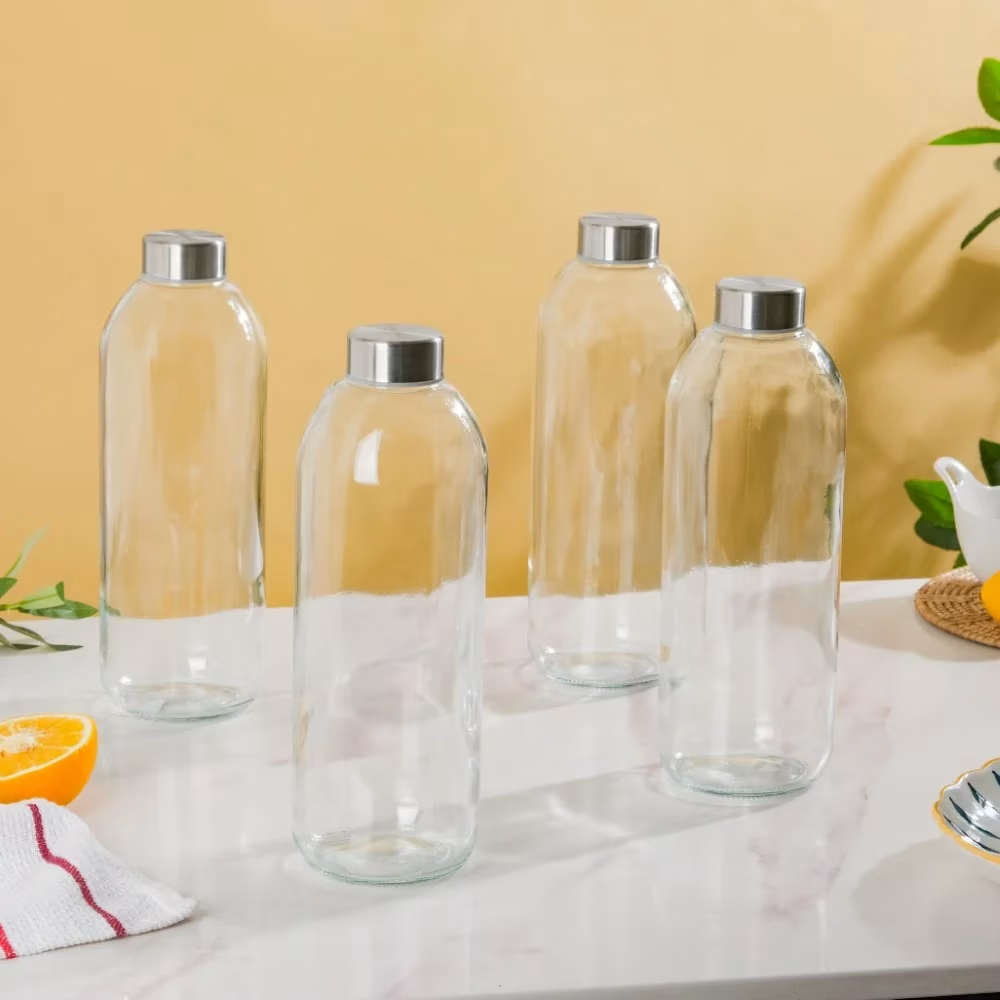
There is something about drinking from glass that plastic never quite matches. No lingering taste of yesterday’s lemon water. No metal rim. You can see exactly how much water is left without even lifting it up. Then one day it falls off your kitchen counter and the whole experience ends in one shattered moment. Which raises the real question. Does a protective sleeve really solve the fragility problem enough to make a glass bottle worth it for everyday use?
The truth is yes, but with some caveats. It has to fit the way you really use the bottle.
What Do Protective Sleeves Actually Do?
A sleeve does a couple of modest things. It takes some of the force out of a knock, gives your hand something grippy to hold and stops a cold bottle sweating all over your bag.
The action of flexing is what makes silicone work. When the bottle hits the ground, that rubbery layer squashes and spreads the shock out. Wetsuits are made from neoprene, a closed-cell foam filled with microscopic sealed air bubbles. Those pockets help cushion bumps and slow the movement of heat in and out.
Here’s the part product listings tend to skip. No sleeve makes a glass bottle unbreakable. A tumble on to carpet is usually fine. A drop on to a granite slab or a railway platform is a gamble, sleeve or no sleeve.
Situations Where a Sleeve Earns Its Place
Think about where your bottle spends the day. If it rides in a backpack on a packed Mumbai local, rolls about in the car footwell or sits on a gym floor, a sleeve is close to non-negotiable.
School bags are another obvious case. So are homes with marble or vitrified tile floors, common in newer Indian flats.
Then there’s humidity. Fill a glass bottle from the fridge during a Chennai summer or the monsoon and it’ll be dripping within minutes. A neoprene cover soaks up most of that condensation, so your laptop and paperwork stay dry. Honestly, that alone sells plenty of sleeves.
Grip matters more than people admit, too. Wet hands, soapy hands, sweaty hands after a run: bare glass gets slippery, silicone doesn’t.
Situations Where You Can Skip The Sleeve
Not everyone needs one. If your bottle lives on a desk and only ever travels from the fridge to the dining table, a sleeve adds little beyond a splash of colour.
The same goes if you mostly drink water at room temperature. No cold contents means no sweating, which removes one of the main reasons to bother.
Some people simply find sleeves a nuisance. Water creeps underneath silicone, and if you never pull it off you may find a grey film, or worse, mold, collecting at the base. A careful owner with a sturdy borosilicate glass bottle can get along perfectly well without one.
Silicone vs Neoprene vs Hybrid: How the Materials Compare
Each material solves a slightly different problem.
| Feature | Silicone | Neoprene | Hybrid (silicone base, neoprene body) |
| Drop cushioning | Good, if the fit is snug | Good on the sides, thin at the base on cheap covers | Strongest where it counts, at the base |
| Keeping water cold | Very little | Better; roughly an extra hour or two | Close to neoprene |
| Grip | Excellent | Fair; can feel soft and squashy | Good |
| Condensation | Partly blocked | Mostly absorbed | Mostly absorbed |
| Cleaning | Wipe down; remove now and then | Hand wash; slow to dry | Two parts to look after |
| Typical cost in India | Often included with the bottle | About ₹300 for a 1-litre cover | Usually built into pricier bottles |
Silicone suits anyone whose main worry is dropping things. Neoprene suits commuters who want cold water at 4pm. Hybrids cost more, but the logic holds up: the base takes most of the hits, so that’s where the toughest material belongs.
What to Check Before You Buy
Start with fit. A sleeve that slides around is worse than none, because the bottle can twist free mid-pour. Check the exact capacity and diameter the sleeve was designed for, not just “1 litre”.
Next, turn it over. Plenty of cheap sleeves stop short of the bottom or leave it bare, which is exactly where a falling bottle tends to land.
For silicone, look for food-grade and BPA-free on the label. For neoprene, thicker foam pads and insulates better.
Last of all, check the glass itself. If the glass bottle is ordinary soda-lime glass, no sleeve will protect it from boiling water. Borosilicate copes far better with sudden temperature changes.
Does Paying Extra For A Sleeve Actually Make Sense
Run the numbers. A 1-litre glass bottle sells for roughly ₹360 to ₹560, depending on the model. A decent neoprene cover on Amazon India costs around ₹300. So a sleeve can nearly double your outlay.
Now set that against replacing the bottle. One avoided breakage pays for the sleeve outright, and for a commuter, a parent or anyone with stone floors, that’s likely within a year.
For a bottle that never leaves the desk, the sums don’t work. You’d be paying ₹300 for decoration.
There’s a middle route. Lots of bottles now come with a silicone sleeve already fitted, often for little more than the plain version. If you haven’t bought yet, that’s usually the cheapest way in.
Conclusion
A sleeve won’t turn glass into steel. What it does is cut down the everyday risks, the slips, the knocks, the soggy bag, that make people give up on a glass bottle within a month. If your bottle travels, buy one. If it stays put, keep your money. Either way, check the fit and the base before anything else, because that’s where most sleeves succeed or fail.