The Philippines is one of Southeast Asia’s most extraordinary and diverse travel destinations — an archipelago of 7,641 islands stretching 1,800 kilometres across the western Pacific, where the world’s finest island-hopping destinations in the Palawan group meet UNESCO-listed rice terraces in the Cordillera mountains, world-class diving in Tubbataha Reef and Apo Island shares the calendar with the globe’s largest festival crowds at Sinulog and Ati-Atihan, and every conceivable combination of white-sand beach, jungle waterfall, active volcano, colonial heritage city, and indigenous tribal culture exists within a single country’s borders. Whether you are planning a beach holiday in Palawan’s El Nido or Coron, a Chocolate Hills exploration in Bohol, a surfing adventure in Siargao, a diving expedition to Tubbataha, a Banaue rice terrace circuit, a whale shark encounter in Donsol, or an urban heritage immersion in Intramuros, Manila, choosing the best time to visit the Philippines is the single most important planning decision you will make — because this is a destination where the differences between seasons are not merely about temperature or rainfall, but about what is physically accessible and what is not.
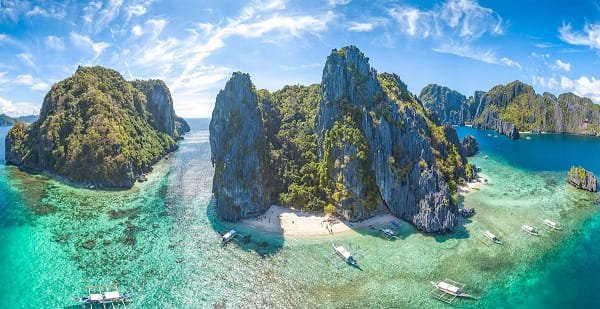
Philippines Travel Overview
| Factor | Details |
| Best Overall Time | November to May |
| Peak Tourist Season | December to March |
| Cheapest Time to Visit | June to October |
| Best for Palawan (El Nido, Coron) | December to May |
| Best for Siargao Surfing | August to November |
| Best for Whale Sharks (Donsol) | February to May |
| Best for Tubbataha Diving | March to June |
| Best for Banaue Rice Terraces | March to May and October to November |
| Best for Budget Travelers | June to September |
| Average Temperature | 25°C to 32°C year-round |
Why Timing Matters Critically in the Philippines
The Philippines spans two monsoon systems — the amihan (northeast monsoon) from November to February and the habagat (southwest monsoon) from May to October — and its archipelagic geography means these systems affect different coasts and different island groups at different times. The Philippine Atmospheric, Geophysical and Astronomical Services Administration (PAGASA) classifies regions into four climate types based on distinct wet and dry season patterns.
The practical implication is profound: when El Nido, Coron, and the Palawan island group on the west coast are sunny and perfect from November to May, the eastern Visayas and Siargao are entering their surf season as the amihan builds. When Siargao is in its best surf window from August to November, typhoon risk is elevated for much of the northern and central Philippines. Understanding these regional differences — rather than applying a single national weather calendar — is essential for planning a Philippines trip that delivers what you came for.
The Typhoon Reality — Understanding the Risk
The Philippines lies in the typhoon belt and experiences 20 or more tropical cyclones annually, with the most destructive typically occurring from August to November. The geographic risk is not uniform — the eastern Visayas and northern Luzon are most exposed, while Palawan, parts of Mindanao, and western-facing coasts are most sheltered. Most typhoons track across the central Philippines or northern Luzon; the Palawan group lies far enough west to be largely protected.
The practical rule: travel insurance covering typhoon disruption is essential for any Philippines trip between June and November. Most trips proceed normally — typhoons are well-tracked and plans can be adjusted with notice — but the risk cannot be ignored.
Visiting the Philippines During Dry Season (November to May)
The dry season — locally divided into the cool dry season from November to February and the hot dry season from March to May — is the Philippines’ most popular and most broadly reliable travel window.
Weather During Dry Season
Temperatures remain consistently tropical at 25°C to 32°C. The cool dry season from November to February is the most comfortable — humidity is lower, breezes are consistent, and evenings are refreshingly cool by Southeast Asian standards. The hot dry season from March to May sees temperatures rising toward 35°C in some locations while remaining ideal for beach and water activities.
Why Visit the Philippines in Dry Season?
- Palawan’s El Nido and Coron are at their absolute finest — turquoise limestone-flanked lagoons, pristine snorkelling and diving, and island-hopping boat tours all operate in perfect conditions from December to May
- Boracay’s famous White Beach is at its most picture-perfect during the amihan months of November to April when consistent northeast winds keep the air clear and the sea calm
- Cebu and Bohol are at peak condition for diving, whale shark encounters near Oslob, and Chocolate Hills exploration from December to May
- The Sinulog Festival in Cebu in January is one of Asia’s most spectacular religious and cultural street festivals
- Donsol’s whale shark season from February to May is at its peak — the world’s most reliable whale shark snorkelling experience
- Tubbataha Reef — a UNESCO World Heritage diving site in the Sulu Sea — is only accessible from March to June when calm sea conditions allow liveaboard boats to make the crossing
Dry season is the most popular and most comprehensively rewarding window for first-time Philippines visitors.
Best Places to Visit
El Nido, Palawan
The crown jewel of Philippine island hopping — a network of 45 islands and islets with dramatic karst limestone cliffs, hidden lagoons, and some of Southeast Asia’s finest beaches. El Nido is at its absolute best from December to April when tour boats navigate calm waters between limestone formations in brilliant sunshine.
Coron, Palawan
Famous for WWII Japanese shipwreck diving — among the world’s finest wreck diving — and the extraordinary Kayangan Lake, Coron is most perfectly visited from November to May when visibility in the Sulu Sea reaches 30 metres and lake conditions are crystal clear.
Boracay
Recentlly restored after a government-mandated environmental rehabilitation, Boracay’s famous White Beach is most perfectly experienced during the amihan season from November to April when the wind comes from the northeast, keeping the beach conditions ideal and the water clean and calm.
Chocolate Hills, Bohol
The surreal landscape of over 1,200 perfectly conical hills turning chocolate brown in summer — best appreciated from March to May when the dry season reveals the distinctive brown colouring that gives them their name.
Advantages of Dry Season Travel
- All island-hopping, diving, and beach activities at peak condition
- Typhoon risk is essentially zero from November to April
- Palawan accessible in its finest weather window
- Major festivals including Sinulog (January) and Ati-Atihan create extraordinary cultural experiences
- Consistent sunshine for full-day outdoor activities
Disadvantages
- December to February is peak season with the year’s highest accommodation prices
- Christmas and New Year period sees maximum domestic traveller numbers
- El Nido and Coron can feel crowded during peak December to March
- Advance booking essential for popular tours and accommodation 2 to 3 months ahead
December to February — The Philippine High Season
December through February is the Philippines’ most popular international travel window — combining the finest weather, the most active festival calendar, and the complete accessibility of the western archipelago’s finest destinations.
What Makes December to February Special?
- Sinulog Festival in Cebu in January — one of Asia’s most spectacular festival street parties, honouring the Santo Niño with millions of participants in colourful costumes dancing through the city streets
- Panagbenga Flower Festival in Baguio — the Mountain Province’s floral festival in February showcasing the highland city’s extraordinary flower garden heritage
- Christmas in the Philippines is uniquely extended — the world’s longest Christmas season begins in September but peaks spectacularly in December with elaborate parols (lanterns) illuminating every community
- Boracay, El Nido, and Coron are at their clearest and most accessible
- The cool northeast amihan brings the most comfortable temperatures and the least humidity of the year
March to May — Hot Season Sweet Spot
March to May is increasingly considered the finest travel window for specific activities — the beaches are at maximum sun exposure, the Tubbataha liveaboard season is in full operation, and the Chocolate Hills wear their distinctive brown summer colouring.
Why March to May is Special
- Tubbataha Reef diving season — only accessible from March to June making this the only window for the Philippines’ most spectacular dive site
- The Chocolate Hills of Bohol turn their distinctive chocolate brown colouring in March to May when the dry season reaches its peak
- Donsol whale shark season continues through May with large populations consistently encountered
- All beach and water destinations are fully accessible with minimal rainfall risk
- Banaue Rice Terraces are beautifully green in April and May before the rice planting season begins
Visiting the Philippines During Wet Season (June to October)
The wet season brings the Philippines’ most complex travel considerations — typhoon risk, heavy rainfall, and rough seas in many areas — but also reveals the archipelago’s most dramatically lush version, lowest prices, and some of its most appealing regional counter-seasons.
Weather During Wet Season
Temperatures remain consistently tropical at 27°C to 33°C with humidity high. Rainfall typically comes in intense afternoon bursts rather than all-day downpours in many areas. The wettest period is September to October when typhoon activity peaks.
Why Some Travellers Visit in Wet Season?
- Siargao Island enters its finest surf season from August to November — the world-famous Cloud 9 reef break produces its best waves during the habagat and typhoon season swells
- Palawan (El Nido and Coron) is more sheltered from typhoons than the eastern Philippines — visits to western Palawan can proceed in June and July before the habagat reaches full intensity
- Hotel prices across the Philippines drop dramatically — 40 to 60 percent below peak season rates
- Fewer tourists create a more authentic, uncrowded version of popular destinations
- The lush green landscape in monsoon is most vividly beautiful
Popular Wet Season Destinations
Siargao — Surf Season
Siargao’s famous Cloud 9 reef break — a powerful right-hand barrel wave — produces its finest surf conditions from August to November when southwest monsoon swells and typhoon-generated groundswells create the largest, most powerful waves. The Siargao International Surfing Cup is held in September or October when the surf is at its peak.
Mindanao — Counter-Season Destination
Parts of Mindanao including Davao, General Santos, and Cotabato experience a different climate pattern — drier conditions precisely during the Philippine wet season. The Kadayawan Festival in Davao in August and the T’nalak Festival in South Cotabato in August celebrate the harvest season in a region that is typically dry when the rest of the Philippines is wet.
Advantages of Wet Season Travel
- Dramatic price reductions — 40 to 60 percent below peak on all accommodation
- Siargao surf season is the primary appeal for serious surfers
- Mindanao destinations are often counter-seasonal — dry when the north is wet
- Lush green landscape photography is most vivid
Disadvantages
- Typhoon risk real and elevated from August to October for northern and central Philippines
- El Nido and Coron island hopping tours can be suspended for days due to rough seas in July to September
- Tubbataha diving season is closed during wet season
- Flexibility in itinerary essential — fixed bookings carry higher disruption risk
Best Time to Visit the Philippines by Destination
Palawan (El Nido, Coron, Puerto Princesa)
Best months: December to May. Avoid July to October when seas become rough and island tours are suspended.
Boracay
Best months: November to April (amihan season) for White Beach’s finest conditions. May to October sees the wind direction reverse, making the eastern Bulabog Beach the active shore.
Siargao
Best months: August to November for world-class surfing. December to July is the off-surf season but offers calmer conditions for island exploring.
Bohol (Chocolate Hills, Tubbataha Diving)
Best months: March to May for the Chocolate Hills’ brown colouring and Tubbataha’s open season. December to February for general sightseeing in the best weather.
Cebu
Best months: December to May for Oslob whale sharks, diving, and sightseeing. January for Sinulog Festival.
Banaue Rice Terraces, Luzon
Best months: October to March for the clearest weather and most comfortable trekking to the terraces. March to May offers the dramatic brown harvest-ready terrace colouring.
Festivals and Events in the Philippines
Sinulog Festival
Held every third Sunday of January in Cebu City, Sinulog is one of Asia’s largest and most spectacular religious-cultural festivals — millions of participants in colourful traditional costumes dance the sinulog steps through the streets in a nine-day celebration honouring the Santo Niño (Child Jesus).
Ati-Atihan Festival
Held in January in Kalibo, Aklan near Boracay, the Ati-Atihan is a multi-day street festival where participants paint their faces black and wear traditional indigenous costumes in a joyful, chaotic celebration.
MassKara Festival
Held every October in Bacolod City, Negros Occidental, the MassKara features performers in elaborate, smiling mask costumes dancing through the streets in one of the Philippines’ most visually distinctive festivals.
Travel Tips for Visiting the Philippines
To make your Philippines trip most rewarding, consider these essential guidelines:
- Purchase comprehensive travel insurance covering typhoon disruption for any visit between June and November — this is not optional.
- Book El Nido and Coron island tours at least 2 to 3 days in advance in peak season — tour slots are limited.
- A10-day to 2-week trip allows you to experience two or three island destinations meaningfully — choose between Palawan, Visayas (Cebu-Bohol), or Mindanao rather than trying to cover all simultaneously.
- InterIsland flights with Cebu Pacific, Philippine Airlines, and AirAsia connect major destinations — book early as routes sell out during peak season.
- Cash in Philippine pesos is essential at smaller islands — ATMs do not exist in El Nido town proper and Coron has limited banking.
- Apply mosquito repellent daily regardless of season — dengue fever is present in the Philippines year-round.
- Learn basic Tagalog courtesy phrases — Filipino hospitality responds warmly to even minimal language effort.
Conclusion
The best time to visit the Philippines is from November to May — the dry season window that provides the most reliable weather across the broadest range of destinations, from Palawan’s paradise lagoons to Cebu’s festival streets to Bohol’s Chocolate Hills. December through April delivers the most consistent sunshine, the calmest seas for island hopping, and the full accessibility of the western archipelago’s finest destinations.
For the Philippines’ full diversity, the timing insight to remember is regional: Palawan peaks in December to May, Siargao peaks in August to November, Tubbataha only opens in March to June, and the whale sharks of Donsol are best encountered in February to May. A well-planned Philippines itinerary aligns its destinations with their individual seasonal peaks rather than applying a single national timing.
Whether you come for El Nido’s hidden lagoons, Siargao’s Cloud 9 barrels, Tubbataha’s reef walls, the Sinulog Festival’s million-strong streets, the Chocolate Hills’ surreal landscape, or the whale sharks of Donsol, the Philippines delivers island experiences that rival any destination in the world — as long as you time your visit to match what you came to see.
Frequently Asked Questions
Q1. What is the best month to visit the Philippines overall?
A: February to April is the most universally recommended window — the dry season is fully established across most of the archipelago, El Nido and Coron are at their finest, Donsol whale shark season is active, and temperatures are warm but not at their most oppressive.
Q2. When is typhoon season in the Philippines?
A: Typhoon risk peaks from August to October, with September statistically the most active month. The eastern Visayas and northern Luzon are most exposed; western Palawan is most sheltered. Travel insurance covering weather disruption is essential during this period.
Q3. Is El Nido accessible in monsoon?
A: El Nido’s island hopping tours can be suspended for days during the peak habagat from July to September when seas are rough. It is not recommended as a primary destination in this window. November to May is El Nido’s reliable season.
Q4. When is the best time to visit Siargao for surfing?
A: August to November — when southwest monsoon and typhoon-generated swells produce the most powerful and consistent waves at Cloud 9 and the island’s other reef breaks.
Q5. How many days are enough for the Philippines?
A: A 10 to 14-day trip comfortably covers one to two island regions — for example, Manila for two days, Palawan (El Nido and Coron) for five days, and Cebu-Bohol for four days, with inter-island flights connecting them.