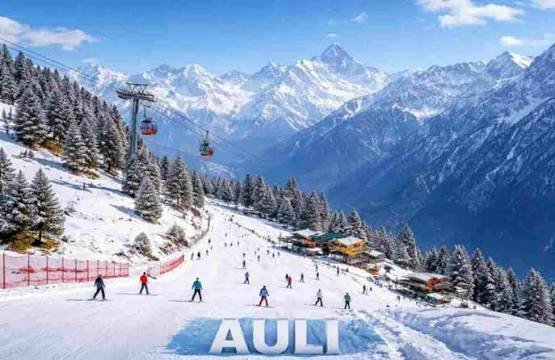
Auli is India’s premier skiing destination and one of its finest year-round Himalayan escapes — a high-altitude meadow in the Garhwal Himalayas of Uttarakhand, sitting at 2,519 to 3,050 metres on the slopes above Joshimath, famous for its world-class ski slopes with a 4-kilometre ski run and 500-metre vertical drop, the panoramic views of over a dozen Himalayan peaks including Nanda Devi — India’s highest entirely domestic peak at 7,816 metres — the Dunagiri, Trishul, Nilkantha, and Kamet massifs visible simultaneously from a single viewpoint, Asia’s longest cable car (gondola) stretching 4 kilometres from Joshimath town to Auli’s upper slopes, a summer landscape of apple orchards and wildflower meadows that draws trekking and nature enthusiasts from June to September, and its position as the gateway to the Kuari Pass trek — one of the finest Himalayan panorama treks in India. Whether you are planning India’s finest skiing holiday, a panoramic Himalayan viewpoint experience, a flower meadow trek, or a cable car ride above the Garhwal Himalayas, choosing the best time to visit Auli determines which of these entirely different versions of the destination you will experience.
Auli Travel Overview
| Factor | Details |
| Best Overall Time | January to March (skiing) and May to June (summer) |
| Peak Tourist Season | January to February and May to June |
| Cheapest Time to Visit | April and September to November |
| Best for Skiing | January to March |
| Best for Mountain Views | January to April and October to November |
| Best for Trekking | May to June and September to October |
| Best for Honeymoon | December to January and May to June |
| Best for Families | May to June and December to January |
| Best for Photography | January (snowscape) and May to June (flowers) |
| Average Temperature | Minus 8°C to 20°C (varies by season) |
Why Timing Matters When Visiting Auli
Auli is fundamentally a destination of two completely different characters depending on season. In winter — December to March — it is a snow-covered ski resort offering the finest skiing slopes in India beneath spectacular Himalayan views. In summer — May to September — the snow retreats, the meadows erupt in wildflower colour, apple orchards blossom, and the landscape becomes a green, peaceful mountain meadow ideal for trekking and nature exploration. The two experiences are so different that choosing between them is less about weather preference and more about what kind of holiday you are seeking.
The additional consideration is Auli’s connection to the Char Dham Yatra pilgrimage circuit — Badrinath is 43 kilometres from Joshimath, and Auli sits directly on the approach route. During the Char Dham season from May to November, the Badrinath highway carries significant pilgrimage traffic that affects travel time and accommodation availability in Joshimath.
Visiting Auli During Winter (December to March)
Winter transforms Auli into India’s finest skiing destination — a clean, high-altitude snowscape with some of the best natural ski conditions in Asia. The ski season is the primary reason most first-time visitors choose this period.
Weather During Winter
Temperatures at Auli range between minus 8°C and 8°C — genuinely cold with temperatures frequently below zero. Snowfall typically begins in late November and builds through December. January carries the heaviest and most consistent snowfall with a snow depth of up to 3 metres on the slopes in good years. The season continues through February and March when snow conditions remain excellent while temperatures begin moderating slightly.
In January 2026, Auli received 45 centimetres of snowfall in a single event on January 23rd — establishing peak conditions that extended well into February. The artificial snow-making lake — the world’s highest man-made lake used specifically for artificial snowmaking when natural snowfall is insufficient — has been operational at Auli since 2011, providing a backup guarantee for ski season conditions.
Why Visit Auli in Winter?
- India’s finest ski slopes with a 4-kilometre main run and natural powder snow in ideal years
- Garhwal Mandal Vikas Nigam (GMVN) skiing courses for beginners and intermediate skiers with certified instructors
- National Skiing and Snowboard Championships frequently held at Auli in January and February
- The panoramic view of Nanda Devi, Mana, Kamet, Dunagiri, and Trishul from the cable car top station and ski slopes is the finest single mountain panorama in accessible India
- Asia’s longest cable car — the Joshimath-Auli Gondola — operates through winter providing access without requiring the steep foot trail
- Snowfield photography from the artificial lake viewpoint with Nanda Devi reflected — one of the finest mountain photography compositions in the Himalayas
Winter is the season that defines Auli’s national identity and attracts the largest number of visitors.
Best Winter Activities
Skiing and Snowboarding
The main ski run from the top cable car station descends 3 to 4 kilometres through natural forest and open snowfield. GMVN operates ski equipment rental and certified instruction courses for beginners. More experienced skiers can explore the open snowfields above the main run. Snowboarding is available on designated sections.
Cable Car Ride to Auli
The Joshimath-Auli Gondola covers 4 kilometres through forest and open Himalayan meadow in approximately 20 to 25 minutes, ascending from 1,890 metres in Joshimath to the Auli slopes at 3,010 metres. The panoramic view of the Himalayan range during the ride is extraordinary even before reaching the ski slopes.
Snowfield Walking and Photography
For non-skiers, winter Auli offers snowfield walking, snow play, and photography from the top station and artificial lake viewpoint — experiences that don’t require skiing skills but provide full access to the winter wonderland atmosphere.
Advantages of Winter Travel
- India’s finest skiing conditions with natural powder snow
- The Nanda Devi panorama under winter clarity is incomparably dramatic
- The Gondola cable car operates providing comfortable access
- National skiing championships create a festive atmosphere in peak weeks
- Snow photography opportunities are outstanding
Disadvantages
- Temperatures of minus 8°C and below require serious cold weather gear
- Accommodation in Auli is limited — most visitors base in Joshimath where options are broader
- January and February peak weeks fill accommodation quickly — advance booking 4 to 6 weeks ahead essential
- Road access to Joshimath can be temporarily blocked during heavy snowfall events
- January 2026 saw the Auli Ropeway operational from 9 AM to 4:30 PM — check current operational hours as they change with weather conditions
January to March — The Ski Season Sweet Spot
January is Auli’s finest individual month for skiing — the snow depth is at maximum, conditions are perfectly dry and powdery, and the clarity of mountain views on clear days is extraordinary.
What Makes January to March Special?
- Peak snowfall season with snow depths of 1.5 to 3 metres on the main slopes
- Natural powder snow conditions — the finest for skiing and snowboarding
- National Skiing Championships typically held in January or February
- The artificial snow lake at 3,006 metres reflects the Nanda Devi massif in early morning on clear days — one of India’s most photographed Himalayan compositions
- Temperature range of minus 4°C to 5°C creates perfect dry, cold conditions
- The forest of oak, conifer, and rhododendron trees surrounding the slopes create a picturesque winter skiing landscape unlike any other Indian resort
Book January and February skiing accommodation in Joshimath or at GMVN Auli resort at least 4 to 6 weeks in advance — peak season demand is high and options are limited.
Visiting Auli During Summer (May to June)
Summer reveals Auli’s entirely different character — the ski slopes become wildflower meadows, apple orchards bloom across the surrounding hillsides, and the mountain landscape transitions from the dramatic monochrome of winter to a vivid, colourful expression of high-altitude spring and summer.
Weather During Summer
Temperatures range between 10°C and 20°C at Auli — pleasantly cool, comfortable for extended outdoor activity, and a genuine relief from the plains’ summer heat. May and June are the finest months with clear skies before the monsoon arrives in late June or early July.
Why Visit Auli in Summer?
- The ski slopes transform into wildflower meadows with alpine species including primulas, violets, anemones, and various species unique to the Garhwal Himalaya
- Kuari Pass Trek — one of India’s finest panoramic Himalayan treks — is most accessible and most rewarding from May to June when the trail is clear and the wildflowers are at peak bloom
- Apple orchards around Auli and the surrounding Joshimath valley are in blossom during May creating beautiful photographic landscapes
- Valley of Flowers National Park — accessible from Govindghat just 25 kilometres from Joshimath — opens in early June
- Hemkund Sahib gurdwara at 4,329 metres opens in May for the pilgrimage season
- The approach to Badrinath Dham — 43 kilometres from Joshimath — is fully operational for the Char Dham Yatra
- The cable car operates providing panoramic mountain views without the winter cold
- Auli’s GMVN resort offers accommodation surrounded by a summer meadow of exceptional natural beauty
Best Summer Activities
- Kuari Pass Trek — a 4 to 6-day Himalayan panorama trek passing through oak and rhododendron forests and high-altitude meadows with continuous Himalayan mountain views
- Gorson Bugyal Trek — a gentler 2 to 3-day meadow trek through high-altitude grasslands
- Valley of Flowers day trip or multi-day trek from Govindghat
- Cable car rides over the blooming summer meadows
- Apple orchard walks in the surrounding Joshimath valley
- Badrinath Dham visit as a day trip or overnight from Joshimath
Benefits of Summer Travel
- Wildflower blooms transform the ski slopes into meadow splendour
- Comfortable temperatures for trekking and outdoor activities
- Trekking routes to Kuari Pass and Gorson Bugyal most accessible
- Valley of Flowers accessible from Govindghat nearby
- The Char Dham pilgrimage atmosphere adds spiritual richness to the mountain experience
Drawbacks
- Ski slopes are snow-free — no skiing or snow sports available
- Monsoon arrives from late June bringing rain and occasional disruption
- Char Dham season creates significant traffic on the Badrinath highway from May
Visiting Auli During Autumn (September to November)
Autumn is Auli’s quietest and most underrated season — the monsoon retreats leaving the surrounding forests intensely green, the sky clearing to brilliant October blue, and the first dusting of winter snowfall appearing on the highest peaks while the lower meadows retain their summer green.
Weather During Autumn
Temperatures range between 5°C to 15°C in October — brisk, clear, and perfectly comfortable for outdoor activity. November sees temperatures dropping progressively toward winter levels as the first significant snowfall arrives on the upper slopes.
Why Visit Auli in Autumn?
- Crystal-clear post-monsoon views of the Himalayan panorama — Nanda Devi and the surrounding peaks are most clearly visible in October’s transparent air
- The surrounding Garhwal forests turn golden and amber in October creating extraordinary autumn colour photography
- Minimal tourists — the most peaceful and solitary version of Auli with accommodation at its most available and affordable
- First snowfall on high peaks creates dramatic photography contrast against the green lower slopes
- All trekking routes including Kuari Pass remain accessible through October
- The Valley of Flowers closes in late October — September is the final opportunity for this extraordinary trek
Popular Autumn Attractions
Nanda Devi Panorama in October
The 7,816-metre summit and its satellite peaks are most consistently and most dramatically visible in October when the transparent post-monsoon air and low-angle autumn sunlight create extraordinary Himalayan photography conditions from Auli’s cable car top station.
Gorson Bugyal in Autumn
The high-altitude grassland above Auli — one of the finest meadow landscapes in Uttarakhand — takes on rich golden autumn tones in October, creating exceptional landscape photography with snow-capped peaks above and golden meadow below.
Advantages of Autumn Travel
- Finest mountain view clarity of the entire year
- Minimum crowds and most comfortable accommodation availability
- Autumn colour photography is exceptional
- All trekking routes still accessible
- Lowest accommodation rates of the pleasant-weather season
Disadvantages
- Skiing is not available — first ski conditions only arrive from late November or December
- November sees progressively cold weather requiring warm clothing
- Some facilities begin reducing operations from late October
Visiting Auli During Monsoon (July to September)
The cable car is operational but ski slopes are bare meadow, trekking can be slippery and disrupted by monsoon rain, and the overall experience is most rewarding for those seeking solitude and the most dramatically green version of the landscape.
Weather During Monsoon
Temperatures range between 12°C and 18°C with regular afternoon to evening rainfall. The surrounding forests become extraordinarily lush but trails are muddy and wet.
Why Some Travellers Visit in Monsoon?
- The Valley of Flowers — Auli’s most famous nearby attraction — is at peak bloom from July to August
- The landscape is the most dramatically green of any season
- Accommodation rates are lowest of the year
- Solitude — the resort is almost completely crowd-free
Advantages of Monsoon Travel
- Valley of Flowers at peak bloom is the primary draw
- Absolute solitude at the resort itself
- Lowest accommodation rates
Disadvantages
- Trekking is disrupted by rain and slippery trails
- No skiing available
- Cable car occasionally suspended during heavy rain
- Mountain views are frequently cloud-obscured
Best Time to Visit Auli for Different Travellers
For Skiers and Snow Lovers
January to March is the non-negotiable window — December provides early season conditions and March extends into late season, but January and February provide the deepest, most reliable powder snow for skiing and the most dramatic snowscape photography.
For Honeymooners
December to January for the most romantic snow-covered landscape experience, or May to June for the wildflower meadow and cable car experience in pleasantly warm conditions — both create genuinely beautiful honeymoon settings.
For Families
May to June is the finest family month — comfortable temperatures, all cable car and trekking accessible, no extreme cold for children, and the wildflower landscape creating a memorable mountain experience for all ages.
For Photographers
January for winter snowscape and Nanda Devi panorama, June for wildflower meadow blooms, and October for autumn foliage and crystal-clear mountain views — three entirely different but equally spectacular photography seasons.
For Trekkers
May to June for Kuari Pass and Gorson Bugyal treks in wildflower season, and September to October for post-monsoon trekking with outstanding mountain views and autumn colours.
The Kuari Pass Trek from Auli
The Kuari Pass Trek is Auli’s signature summer and autumn trekking experience.
Ideal Months
May to June and September to October.
The trek covers:
- Starting point at Auli or Dhak village (accessible from Joshimath)
- Trekking through oak and rhododendron forests above Joshimath valley
- High-altitude meadows at Gorson Bugyal and Tali
- Kuari Pass at 3,640 metres — a panoramic viewpoint showing Nanda Devi, Kamet, Dunagiri, Hathi Parbat, and over a dozen other peaks simultaneously
- Total distance approximately 27 to 34 kilometres depending on route variant
- Trek duration 4 to 6 days
The Kuari Pass is considered one of the finest mountain panorama treks accessible to moderately fit hikers in all of India.
Festivals and Events in Auli
National Skiing Championships
Typically held in January or February, the national skiing and snowboarding championships organised at Auli bring competitive athletes and spectators to the slopes — creating an energetic, festival-like atmosphere around the ski runs.
Auli Winter Festival
GMVN organises cultural programmes, folk performances, skiing demonstrations, and adventure activity events during the peak January ski season that add a festive dimension to the primary sports experience.
Char Dham Season Opening
When Badrinath Dham opens in April or May, a religious atmosphere fills the entire Joshimath-Badrinath corridor — the proximity to this sacred pilgrimage destination gives Auli’s summer season a spiritual dimension absent in winter.
Travel Tips for Visiting Auli
To make your Auli trip most rewarding, consider these practical guidelines:
- Book January and February skiing accommodation in Joshimath or at GMVN Auli resort at least 4 to 6 weeks in advance — peak ski season fills quickly.
- The Auli Ropeway (Gondola) operates from approximately 9 AM to 4:30 PM daily in winter — check current operational hours with GMVN before planning your day.
- For skiers, GMVN provides ski equipment rental including skis, boots, and poles — carry your own if you have specific preferences as rental quality varies.
- Carry warm waterproof gear for winter visits — temperatures drop rapidly after 3 PM and wind chill on the slopes makes minus 8°C feel significantly colder.
- The road from Haridwar to Joshimath covers approximately 265 kilometres — plan 8 to 10 hours for the journey.
- Altitude at Auli (3,050 metres) can cause mild altitude symptoms — allow one day in Joshimath before ascending to the slopes.
- The Forest Department requires visitors to return from the slopes and surrounding forests by 4 PM in winter due to wildlife activity and rapid temperature drops after sunset.
Conclusion
The best time to visit Auli is January to March for skiing — when India’s finest ski slopes offer natural powder snow, the Nanda Devi panorama is at its clearest and most dramatic, and the entire mountain experience is at its winter peak — and May to June for the summer meadow experience — when wildflower blooms replace the ski runs, the Kuari Pass trek is at its most rewarding, and the cable car transports you through a Himalayan landscape at its most colourful.
January stands out as Auli’s single finest month — the deepest snow conditions, the most reliable powder, the dramatic Himalayan panorama under clear winter sky, and the festive atmosphere of the National Skiing Championships combine for the most complete winter mountain experience India can offer.
Whether you come for the ski slopes, the cable car panorama, the Kuari Pass wildflowers, the Nanda Devi sunrise, the apple orchards, or simply the extraordinary experience of standing at 3,000 metres in the Garhwal Himalayas watching India’s highest peaks reflect in a glacial lake, Auli rewards every kind of mountain traveller with experiences of genuine world-class quality.
Frequently Asked Questions
Q1. What is the best month to visit Auli for skiing?
A: January is the finest month — peak snowfall, deepest powder conditions, best slope conditions, National Skiing Championships atmosphere, and the most dramatic Nanda Devi panorama under clear winter sky.
Q2. Does Auli get snow every year?
A: Natural snowfall begins from late November and builds through January and February in most years. The artificial snowmaking lake at 3,006 metres supplements natural snowfall in low-snow years to maintain ski slope conditions.
Q3. What is Auli like in summer?
A: Completely transformed — the ski slopes become wildflower meadows, apple orchards bloom around Joshimath, the Kuari Pass trek is in its finest season, and temperatures of 10°C to 20°C make outdoor activity genuinely comfortable.
Q4. How do I reach Auli?
A: Reach Joshimath by road from Rishikesh (250 kilometres, 8 to 10 hours) or Haridwar (265 kilometres). From Joshimath, the 4-kilometre Gondola cable car ascends to Auli in 20 to 25 minutes. A steep 5-kilometre foot trail is also available.
Q5. How many days are enough for Auli?
A: A 2 to 3-day stay is sufficient for the cable car, ski slopes or meadow walks, and the Nanda Devi panorama. Extend to 5 to 7 days to include the Kuari Pass Trek or a day trip to Valley of Flowers and Badrinath.