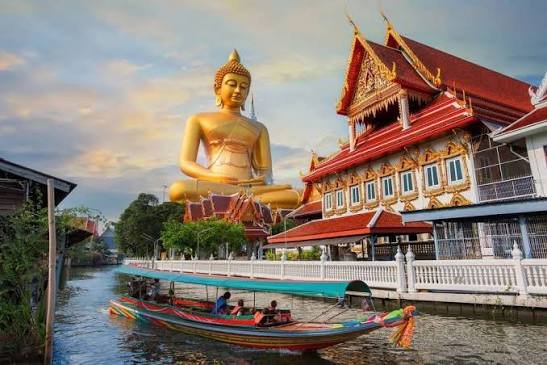
Bangkok is one of Southeast Asia’s most extraordinary and most visited cities — the Thai capital where ancient golden temples rise above river canals and futuristic glass skyscrapers, where the world’s most celebrated street food is served from carts parked beside 200-year-old palace walls, where the Chao Phraya River carries longtail boats past royal barges and Wat Arun’s exquisite porcelain-mosaic spires, and where the contrast between morning monk processions through dawn-quiet alleyways and the neon-blazing night markets of Yaowarat’s Chinatown creates one of the most sensory-rich urban experiences on earth. Famous for the Grand Palace complex and Wat Phra Kaew (Temple of the Emerald Buddha), the boat-accessible temple of Wat Arun, the floating markets of Damnoen Saduak and Amphawa, the ancient canals of Thonburi, Chatuchak Weekend Market’s 15,000 stalls, the rooftop bars above the Silom skyline, the authentic Thai cooking classes in Banglamphu, and the Songkran Festival’s city-wide water celebrations, Bangkok rewards visitors with a depth and variety of experience that makes it one of the world’s most re-visited cities. Whether you are planning a first temple circuit, a culinary immersion, a Songkran celebration, a riverside heritage cruise, a shopping expedition, or a cultural deep-dive into Thailand’s royal and Buddhist traditions, choosing the best time to visit Bangkok shapes your comfort, your festival access, and the complete character of your city experience.
Bangkok Travel Overview
| Factor | Details |
| Best Overall Time | November to February |
| Peak Tourist Season | December to January |
| Cheapest Time to Visit | June to October |
| Best for Temples and Sightseeing | November to February |
| Best for Songkran Festival | April 13 to 15 |
| Best for Loy Krathong | November (full moon) |
| Best for Honeymoon | November to February |
| Best for Budget Travelers | June to September |
| Best for Street Food | Year-round |
| Average Temperature | 25°C to 40°C (varies by season) |
Why Timing Matters When Visiting Bangkok
Bangkok experiences three distinct seasons — a cool dry season from November to February, a hot season from March to May, and a rainy season from June to October. The city sits 14 degrees north of the equator at sea level, which means temperatures are warm throughout the year, but the differences in humidity, rainfall, and temperature between the cool season and the rainy season are significant enough to create genuinely different travel experiences.
The Songkran and Loy Krathong festivals add cultural timing dimensions that make specific weeks within the calendar particularly rewarding for visitors who plan their trip around these extraordinary celebrations.
Visiting Bangkok During Cool Season (November to February)
The cool season is universally considered the best time to visit Bangkok — the only period when the tropical heat and humidity ease enough to make extended outdoor sightseeing genuinely comfortable, the skies are consistently blue, and the city is at its most photogenic and most activated.
Weather During Cool Season
Temperatures range between 22°C and 32°C — warm and tropical but with the lowest humidity of the year, providing a relative comfort that makes all-day temple exploration and street food wandering genuinely enjoyable rather than exhausting. November mornings can feel almost cool at 22°C after the receding monsoon.
Why Visit Bangkok in Cool Season?
- The Grand Palace and Wat Phra Kaew — Bangkok’s most iconic heritage site — are most pleasantly visited in the comfortable morning air before 10 AM
- Wat Pho’s enormous reclining Buddha and Wat Arun’s riverside setting are most beautifully lit under clear blue cool-season sky
- The night markets at Asiatique, Rod Fai, and Chatuchak are most vibrant in the comfortable evening temperatures
- Rooftop bars at Vertigo, Sky Bar, and Octave offer the finest city panoramas under clear cool-season skies
- Canal boat rides through Bangkok’s network of khlongs are most enjoyable without the oppressive humidity of the rainy season
- The Chao Phraya river cruise between the Grand Palace, Wat Arun, and the Asiatique pier is most atmospheric in the golden afternoon light of November to February
- Chinese New Year in January or February brings Chinatown’s Yaowarat Road to spectacular life with dragon dances, red lanterns, and the finest street food excess of the entire year
- Loy Krathong — held on the full moon of November — releases thousands of lanterns and floating lotus-shaped offerings onto the Chao Phraya in one of Thailand’s most beautiful festival moments
Cool season is the most celebrated and most fully rewarding season for the complete Bangkok experience.
Best Places to Visit
Grand Palace and Wat Phra Kaew
The centrepiece of Bangkok’s royal heritage — the dazzlingly ornate complex of gilded ceremonial halls, the Temple of the Emerald Buddha, and the hundreds of intricately decorated kinnaris and yaksha guardian figures — is most comfortably and most beautifully explored in the cool-season morning air. Arrive before 9 AM on a weekday for the most peaceful experience and the finest photography light.
Wat Arun — Temple of Dawn
The Chao Phraya’s most distinctive landmark — its central prang rising 79 metres and encrusted with porcelain mosaic fragments — is most beautifully photographed from across the river in the early morning cool-season light when the sun hits its eastern face directly.
Chatuchak Weekend Market
The world’s largest weekend market — over 15,000 stalls covering 35 acres — is most pleasantly explored in the comfortable Saturday and Sunday morning cool-season temperatures before the midday heat makes the outdoor sections exhausting.
Floating Markets
Damnoen Saduak and Amphawa floating markets — both accessible as half-day excursions from Bangkok — are most vibrant in the cool morning hours of the cool season when vendors in bamboo-thatched boats sell fresh tropical fruits, pad thai, and grilled corn on a network of Bangkok’s ancient waterways.
Advantages of Cool Season Travel
- Most comfortable temperatures for all-day outdoor sightseeing
- Chinese New Year and Loy Krathong create extraordinary festival moments
- Clear skies for rooftop bar and riverside photography
- All outdoor activities and street food wandering at maximum enjoyment
- Bangkok’s famous night markets most vibrant in pleasant evening temperatures
Disadvantages
- December and January are the year’s most crowded months — the Grand Palace queues are longest, popular rooftop bars require reservations
- Peak season hotel rates — the finest Chao Phraya riverside hotels at their most expensive
- New Year’s Eve in Bangkok sees maximum crowd levels and accommodation prices
- Advance booking of popular hotels essential 2 to 3 months ahead for December and January
November — The Finest Transition Month
November is increasingly recognised as Bangkok’s single finest travel month — the monsoon has fully retreated, temperatures have cooled to their most comfortable, Loy Krathong creates one of Thailand’s most beautiful festival moments, and the year’s peak December crowds have not yet arrived.
What Makes November Special?
- Loy Krathong — the Festival of Lights — is held on the full moon of November, when Thais float lotus-shaped offerings of flowers, incense, and candles on the Chao Phraya River and canals, and launch sky lanterns (khom loi) into the night sky in a display of extraordinary beauty
- Post-monsoon freshness gives Bangkok’s green spaces, canals, and temple gardens their most vivid appearance
- Temperatures at their most pleasant — 22°C to 28°C with minimal humidity
- Hotel rates below the December-January peak
- All outdoor attractions operating at full capacity with manageable crowd levels
Visiting Bangkok During Hot Season (March to May)
The hot season is Bangkok’s most extreme period — temperatures regularly reach 38°C to 40°C and the Songkran Festival turns April into the most uniquely Thai cultural celebration of the entire year, attracting travellers who come specifically for the water festival experience.
Weather During Hot Season
Temperatures range between 30°C and 40°C — April is statistically the hottest month in Thailand, with intense dry heat that makes outdoor midday activity genuinely challenging. Indoor attractions — temples, museums, shopping malls — become the primary daytime destinations.
Why Visit Bangkok in Hot Season?
- Songkran Festival from April 13 to 15 — Thailand’s New Year celebration is the world’s largest water festival. Bangkok’s Silom Road and Khao San Road become extended water battle zones where the entire city participates in water-throwing celebrations that range from gentle traditional ceremonial water pouring to full-scale street battles. This is the most participatory, most purely joyful, and most distinctly Thai festival experience available anywhere in Thailand
- Hotel rates are significantly below the December-January peak — excellent value despite the heat
- Bangkok’s indoor attractions — the Jim Thompson House, the Bangkok Art and Culture Centre, and the city’s extraordinary shopping malls — are most enjoyably explored in well air-conditioned comfort during the hottest months
Best Hot Season Activities
- Songkran water festival participation on Silom Road
- Temple visits limited to early morning before 9 AM
- Museum explorations — National Museum, Siriraj Medical Museum, Bangkok Art and Culture Centre
- Rooftop pool day passes at luxury hotels
- Bangkok’s extraordinary SkyTrain-connected shopping mall circuit
Benefits of Hot Season Travel
- Songkran is the single most unique and most participatory Thai cultural experience
- Hotel rates 20 to 30 percent below cool season peak
- Bangkok’s indoor world is exceptional — best weather to explore its remarkable mall and museum circuit
Drawbacks
- April is the hottest month in Thailand with temperatures reaching 40°C — outdoor midday exploration is genuinely uncomfortable
- Songkran week (April 13 to 15) sees maximum crowd levels and everything gets very wet
- Some temple dress codes require extra planning when anticipating water festival participation
Visiting Bangkok During Rainy Season (June to October)
Bangkok’s rainy season receives its heaviest rainfall in August to October but the pattern is typically afternoon and evening downpours rather than all-day continuous rain — a key distinction that allows most mornings to be bright and dry for sightseeing.
Weather During Rainy Season
Temperatures remain warm at 27°C to 33°C with high humidity. Rainfall typically comes in heavy afternoon bursts of one to two hours. The Chao Phraya can rise significantly and occasional Bangkok flooding affects some street-level areas.
Why Some Travellers Visit in Rainy Season?
- Hotel rates drop dramatically — 40 to 60 percent below cool season peak prices
- Morning hours from 7 AM to noon are typically dry and bright — ideal for temple and market exploration
- Bangkok’s street food culture is most atmospheric in the cooler post-rain evening air
- The city is dramatically less crowded — the Grand Palace’s queues shorten significantly
- September offers the most rewarding rainy season month — rainfall begins easing while temperatures are still warm and prices remain low
Popular Rainy Season Activities
- Morning temple circuit completed before noon rain arrives
- Bangkok’s legendary canal markets before the afternoon downpour
- Rooftop bar visits during the dramatic dry spells between rain events
- Muay Thai matches at Rajadamnern or Lumpini stadiums — fully indoor and most atmospheric in cool rain-freshened evenings
Advantages of Rainy Season Travel
- Lowest hotel rates of the year — dramatic savings on accommodation
- Bangkok’s renowned indoor food scene most enjoyably explored without the distraction of outdoor heat management
- Morning sightseeing is often excellent — temples, canals, and markets without peak crowds
- The city in rain has its own atmospheric, photographic beauty
Disadvantages
- Afternoon flooding can disrupt transportation in some areas
- Outdoor evening markets are occasionally disrupted by sustained rain
- Humidity is highest of the year — the combination of heat and moisture is uncomfortable for extended outdoor activity
Best Time to Visit Bangkok for Different Travellers
For Honeymooners
November to February delivers the most romantic Bangkok experience — the Chao Phraya riverside at Loy Krathong with floating lights on the water, the Grand Palace illuminated under evening floodlights, rooftop dinners above the glittering Bangkok skyline, and the intimate atmosphere of boutique riverside hotels in the most comfortable temperatures of the year.
For Families
November to February provides comfortable temperatures for all ages, the shortest temple queues in peak season mornings, and all outdoor activities and boat tours most enjoyably operational.
For Budget Travellers
June to September — Bangkok’s accommodation drops dramatically, the morning temple circuit is still very rewarding, and the city’s legendary street food and indoor market culture is fully accessible at the year’s lowest prices.
For Festival Lovers
April for Songkran — the most participatory, most uniquely Thai festival experience anywhere in the kingdom. November for Loy Krathong — one of Asia’s most beautiful festival moments with light floating on the Chao Phraya.
For Photographers
November for the Loy Krathong lantern release at Sanam Luang and the Chao Phraya. December and January for the cleanest light on temple spires and the most dramatic rooftop photography under clear cool-season skies.
Best Time for Bangkok’s Temples and Heritage Sites
Bangkok’s temple circuit is the defining cultural experience of any visit.
Ideal Months
November to February for the most comfortable extended temple exploration.
Top temples and heritage sites include:
- Grand Palace and Wat Phra Kaew — arrive before 9 AM for the shortest queues and best photography light
- Wat Arun — cross the Chao Phraya by ferry for the finest view of the porcelain-mosaic prang
- Wat Pho — home to the 46-metre reclining Buddha, most peacefully visited on weekday mornings
- Wat Saket — the Golden Mount, most beautifully visited at sunset for panoramic city views
- Jim Thompson House — the preserved silk merchant’s house in a garden compound, most pleasantly explored in cool-season temperatures
- Bang Krachao — Bangkok’s “green lung” island, most beautifully cycled in the cool season morning air
Festivals and Events in Bangkok
Songkran Festival
Held April 13 to 15 — Thailand’s New Year water festival transforms Bangkok into the world’s largest water battle. Silom Road and Khao San Road are the most active zones in the capital. The traditional ceremonial elements — bathing Buddha images, pouring water on elders’ hands as a blessing — coexist with the street-level exuberance of citywide water fights.
Loy Krathong
Held on the full moon of November, this festival of light sees Bangkok’s canals, the Chao Phraya River, and public spaces filled with thousands of lotus-shaped krathong offerings carrying candles and incense. Sky lanterns (khom loi) released from Sanam Luang create one of Bangkok’s most photographed annual moments.
Chinese New Year — Yaowarat
Bangkok’s Chinatown along Yaowarat Road celebrates the Lunar New Year in January or February with lion dances, dragon processions, elaborate red lantern decorations, and the finest Chinese-Thai street food concentration of the year — a genuinely extraordinary atmospheric experience on one of Asia’s most famous food streets.
Travel Tips for Visiting Bangkok
To make your Bangkok visit most rewarding, consider these practical guidelines:
- Visit the Grand Palace on a weekday rather than a weekend — the difference in queue length is substantial
- The BTS SkyTrain and MRT metro provide efficient transport across most of Bangkok’s tourist areas — purchase a Rabbit card for BTS and a stored-value card for MRT to avoid the need for exact change
- Dress modestly for temple visits — shoulders and knees must be covered. Wraps and sarongs are available for rental at the Grand Palace entrance but carrying your own is more comfortable
- Eat where Thais eat — the finest Bangkok street food is not on Khao San Road but in neighbourhood markets like Or Tor Kor, Yaowarat’s side alleys, and the morning market around Wat Pho
- Negotiate tuk-tuk prices firmly before getting in — always agree on the fare in advance
- Book popular rooftop bars (Sky Bar, Vertigo) in advance for weekends and all December-January evenings
- A Bangkok river pass for the Chao Phraya Express Boat is the most scenic and most economical way to connect between the Grand Palace, Chinatown, and Silom
Conclusion
The best time to visit Bangkok is from November to February — the cool dry season when temperatures are at their most comfortable for extended outdoor temple and canal exploration, the festival calendar includes the extraordinary Loy Krathong in November and Chinese New Year in January-February, and the city is operating at its most vibrant and most fully activated.
November stands out as Bangkok’s single finest month — the Loy Krathong festival creates one of Asia’s most beautiful individual nights of the year, the post-monsoon freshness gives the city its cleanest and most vivid character, and hotel rates are below the December-January peak while conditions are at their most comfortable.
Whether you come for the Grand Palace’s gilded magnificence, the floating markets’ dawn chaos, the Songkran water battle’s joyful madness, the Loy Krathong lights on the Chao Phraya, the rooftop bars’ city panorama, the Chatuchak market’s overwhelming abundance, or simply the street-corner pad thai that the rest of the world has spent fifty years trying to replicate, Bangkok delivers an urban experience of such richness, variety, and sensory intensity that it consistently ranks among the world’s most revisited cities.
Frequently Asked Questions
Q1. What is the best month to visit Bangkok?
A: November is the finest single month — Loy Krathong creates one of Asia’s most beautiful festival moments, post-monsoon freshness gives the city maximum clarity, temperatures are at their most comfortable, and hotel rates are below the December-January peak.
Q2. When is the Songkran Festival in Bangkok?
A: Songkran is celebrated from April 13 to 15 every year — Thailand’s New Year water festival turns Bangkok’s streets, particularly Silom Road and Khao San Road, into the world’s largest participatory water celebration.
Q3. Is Bangkok worth visiting in rainy season?
A: Yes for budget travellers — hotel rates drop 40 to 60 percent, morning temple circuits are often excellent, and Bangkok’s legendary indoor food and market culture is fully accessible. Afternoon flooding can occasionally disrupt transport.
Q4. What is the hottest month in Bangkok?
A: April — temperatures regularly reach 38°C to 40°C making outdoor midday activity genuinely challenging, though Songkran’s water-throwing celebrations on April 13 to 15 provide a uniquely refreshing antidote to the heat.
Q5. How many days are enough for Bangkok?
A: A minimum of 3 to 4 days covers the Grand Palace, Wat Pho, Wat Arun, a floating market excursion, Chatuchak, Chinatown, and an evening at a rooftop bar comfortably. Extend to 5 to 6 days to include day trips to Ayutthaya and Amphawa floating market.