Laminate finish vs PU finish is really a choice between a surface that arrives ready-made and one that’s built up on your furniture coat by coat. A laminate is a factory-produced decorative sheet, glued and pressed onto plywood or HDHMR panels. A PU finish is polyurethane paint, sprayed over a carefully smoothed board in several layers and sanded between coats until it looks like glass, silk or soft velvet. Both are common in Indian kitchens, wardrobes and TV units today. They differ in cost, appearance, how they handle daily wear and what happens when something goes wrong years later.
How Each Finish Is Applied
Laminate work is quick and predictable. The sheet is cut to size, bonded to the board with adhesive, pressed, trimmed and edge-banded. A carpenter can finish a set of shutters in a day or two, and the colour on the last shutter matches the first exactly.
PU is a multi-stage process. The board, usually MDF or HDHMR for its smooth surface, is filled and sealed. Then come several rounds of primer, sanding, base coats and topcoats, with drying time between each. A high-gloss PU kitchen may involve six or more stages. The final quality depends heavily on the painter’s skill, the spray equipment and a dust-free environment.
Shapes, Colours and Edges
PU shines when design gets adventurous. Because it’s sprayed, it wraps seamlessly around rounded corners, curved panels, routed grooves and handle-less profiles. There’s no visible edge strip, so a shutter looks like one continuous piece.
Colour is another strength. PU can be mixed in practically any shade, so it can match a wall colour, a fabric or a tile exactly. That makes it a favourite for statement kitchens in sage green, navy or blush pink.
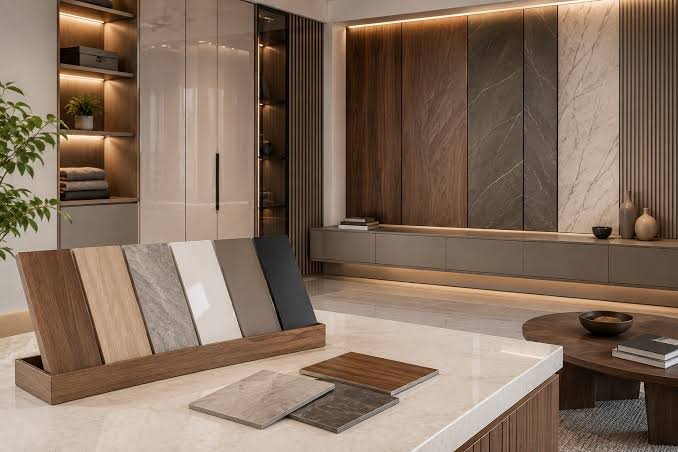
Laminates come in a fixed range, though that range is huge: wood grains, stones, fabrics, metallics, solid colours, matte, suede, high gloss and textured finishes. They suit flat panels best. Gently rounded edges are possible with post-forming laminates, but sharp curves and deep grooves are outside their comfort zone.
Day-to-Day Wear
Scratches and Fingerprints
Laminates have a hard, wear-resistant top layer, so keys, utensils and children’s toys rarely leave a mark. High-gloss PU looks stunning but shows fingerprints and fine scratches more easily. Matte and satin PU are far more forgiving and hide everyday marks well.
Heat, Water and Kitchen Use
Laminate handles steam, splashes and frequent wiping with ease. A well-applied PU finish is also water-resistant and easy to clean, though its edges benefit from careful handling near the sink and hob.
Sunlight and Yellowing
Good laminates hold their colour steadily. With PU, the type of polyurethane matters. Aliphatic, non-yellowing PU keeps whites and pale colours fresh for years, while cheaper aromatic PU can turn slightly cream over time, especially in sunlit kitchens. If you’re choosing a white PU finish, ask for non-yellowing PU by name.
Chips and Repairs
This is where the two take different paths. A deep chip in laminate usually means replacing that sheet, which is straightforward on a single shutter. PU chips can be filled and touched up, and a damaged panel can be fully resprayed to look new. The catch is colour matching, since an aged PU panel may differ slightly from a fresh coat, so painters often respray an entire shutter for an even look.
Factory PU or Site PU?
PU can be applied at a factory or on site in your home, and the result can vary considerably.
Factory PU is sprayed in dust-controlled booths and often cured in ovens, giving a harder, more uniform finish. It costs more but is consistent from shutter to shutter.
Site PU is done in your flat, usually in a spare room turned into a spray area. It can look excellent with a skilled team, but dust, humidity and limited curing time affect quality. It also brings strong smells and several days of work inside the home.
For high-gloss finishes especially, factory PU is worth the extra cost.
Kitchen Shutter Budget
Indicative 2026 figures for finished shutters, including the board, show clear tiers. Laminate on plywood typically runs about ₹95 to ₹180 per square foot at the budget level, ₹180 to ₹280 for mid-range woodgrain and branded designs, and ₹260 to ₹380 for premium options like acrylic laminates. PU on HDHMR generally ranges from ₹400 to ₹550 for two-coat finishes, ₹500 to ₹700 for multi-coat work and ₹700 to ₹900 for premium oven-cured PU.
A 10 ft straight kitchen with base and wall units has roughly 60 square feet of shutter area.
- Mid-range laminate at ₹230 comes to about ₹13,800.
- Mid-range PU at ₹600 comes to about ₹36,000.
A popular middle path is PU on the wall units and a kitchen island, where the finish is seen and admired, with laminate on the base units that face mop water, kicks and the daily rush of cooking.
Where Each Finish Makes Sense
Laminate is the practical choice for kitchens in busy homes, kids’ rooms, study units, wardrobes in rental flats, office furniture and any project where budget and quick installation matter. It looks smart, lasts well and needs almost no care.
PU suits homes where furniture is meant to be a design highlight: curved TV units, handle-less wardrobes, colour-matched kitchens, bar units and premium living room pieces. It rewards owners who are comfortable treating furniture with a little extra care.
Care Tips for Both Finishes
- Clean with a soft microfibre cloth and mild soap solution.
- Avoid abrasive powders, steel scrubbers and harsh solvents.
- Use soft-close hinges and drawer channels to reduce knocks on edges.
- Keep a sample panel or the PU shade code for future repairs.
- Wait for full curing, usually one to two weeks for PU, before heavy cleaning.
FAQs
Q1. Which is better for kitchen cabinets, laminate or PU?
A: Laminate is more durable and economical for busy kitchens, while PU offers a premium, seamless look for design-focused kitchens.
Q2. Does PU finish scratch easily?
A: High-gloss PU can show fine scratches, while matte and satin PU hide everyday wear much better.
Q3. How long does PU finish last?
A: A good PU finish usually lasts 8 to 10 years and can be resprayed to look new.
Q4. Can laminate be used on curved furniture?
A: Laminate suits flat surfaces, though post-forming laminates can handle gently rounded edges.
Q5. Does white PU turn yellow?
A: Cheaper PU can yellow over time, so non-yellowing aliphatic PU is recommended for white finishes.
Q6. Why is PU finish more expensive than laminate?
A: PU needs several coats, sanding, skilled spraying and curing time, which raises labour and material costs.