Arunachal Pradesh is one of India’s most extraordinarily diverse, untouched, and visually magnificent destinations — the Land of the Dawn-Lit Mountains, as its name translates from Sanskrit, a northeastern frontier state bordering Bhutan, Tibet, and Myanmar that packs within its 83,743 square kilometres an astonishing concentration of high-altitude Himalayan landscapes, ancient Buddhist monasteries, pristine jungle wilderness, glacial rivers, tribal cultures of extraordinary richness and diversity, and natural biodiversity unmatched anywhere in India. From the soaring monastery-perched town of Tawang in the west to the primeval Namdapha National Park in the east, from the Ziro Valley’s UNESCO-nominated cultural landscape of the Apatani tribe to the Mechuka Valley’s remote Tibetan-influenced beauty in Shi-Yomi district, from the whitewater rivers of Siang and Kameng to the living root bridges of Daporijo, Arunachal Pradesh offers experiences that most of India’s travellers have not yet discovered and that no other Indian state can replicate. Whether you are planning a monastery circuit, a tribal cultural immersion, a wildlife expedition, a river rafting adventure, a high-altitude trek, or simply an exploration of one of the last great undiscovered corners of the Indian Himalayan world, choosing the best time to visit Arunachal Pradesh determines which version of this extraordinary state you encounter.
Arunachal Pradesh Travel Overview
| Factor | Details |
| Best Overall Time | October to April |
| Peak Tourist Season | November to March |
| Cheapest Time to Visit | June to September |
| Best for Tawang | March to June and September to November |
| Best for Tribal Festivals | January to April |
| Best for Ziro Music Festival | September |
| Best for Wildlife | October to April |
| Best for River Rafting | October to April |
| Best for Budget Travelers | June to September |
| Average Temperature | 0°C to 30°C (varies by altitude and region) |
Why Timing Matters When Visiting Arunachal Pradesh
Arunachal Pradesh’s extreme geographic and altitudinal diversity — from sub-tropical plains at 50 metres elevation in the south to high Himalayan passes above 5,000 metres in the north and west — creates dramatically different regional weather patterns operating simultaneously. When Tawang is under heavy snow in January, the Brahmaputra plains near Pasighat are mild and pleasant. When the monsoon floods the lower river valleys from June to September, the Tawang plateau receives moderate rain that does not prevent travel but does affect road conditions.
Additionally, the mandatory Inner Line Permit (ILP) for Indian citizens and Protected Area Permit (PAP) for foreign nationals adds a planning dimension specific to this state. All visitors must obtain these documents before entering — understanding the permit requirement and the process of obtaining it is as important as understanding the seasonal weather.
Visiting Arunachal Pradesh During Winter (October to February)
Winter is the most consistently popular and most widely recommended time to visit Arunachal Pradesh. The monsoon has retreated, skies are clear, temperatures are pleasantly cool across lower and middle elevations, and the state’s extraordinary cultural festival calendar reaches its most vibrant peak.
Weather During Winter
Temperatures vary dramatically by altitude and region. Lower elevation towns like Itanagar, Pasighat, and Ziro experience temperatures between 10°C and 24°C — comfortable and pleasant. Middle elevation areas including Bomdila, Dirang, and the Siang valley range from 5°C to 18°C. High-altitude Tawang sits at 0°C to 10°C in November, dropping to minus 5°C and below by December and January. Snowfall is regular at Tawang and Bumla Pass from December onwards.
Why Visit Arunachal Pradesh in Winter?
- Clear skies and excellent visibility across the state provide the finest mountain and valley photography conditions of the year
- The Losar Festival — the Tibetan Buddhist New Year celebrated by the Monpa tribe — brings extraordinary mask dances, monastery rituals, and community celebrations to Tawang in January or February
- The Nyokum Yullo Festival of the Nyishi tribe, the Ponung Festival of the Adi tribe, the Ali-Aye-Ligang celebration of the Mising tribe, and dozens of other tribal festivals create an extraordinarily rich cultural calendar from January to April
- Wildlife activity in Namdapha National Park, Pakhui Tiger Reserve, and Eagle’s Nest Wildlife Sanctuary is highest in the cool winter months
- River rafting on the Siang, Kameng, Subansiri, and Lohit rivers is at its most active and best-conditioned in the post-monsoon and winter period
- Orchid blooms begin appearing in the lower elevation forests from February onwards
- The Tawang road circuit — Bomdila, Dirang, Sela Pass, Tawang — is most reliably accessible from October to November and again from March
Winter is the most complete and most broadly accessible season for Arunachal Pradesh travel.
Best Places to Visit
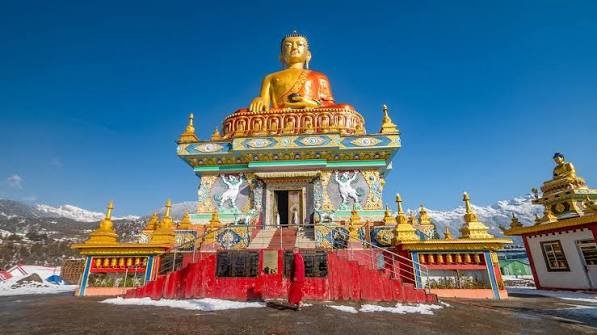
Tawang Monastery
The 17th-century monastery — largest in India, second largest in the world — is most atmospherically visited in winter when snowfall may periodically cover the surrounding landscape and the monastery’s daily rituals continue in crisp Himalayan air with minimal tourist presence compared to spring peak.
Ziro Valley
The UNESCO World Heritage candidate Ziro Valley — home to the Apatani tribe who practise a unique form of paddy cultivation using no ploughs or draught animals — is most pleasantly explored in October and November when the rice fields have just been harvested and the valley is at its most photogenic golden state.
Namdapha National Park
India’s most biodiverse national park and home to all four big cats — tiger, leopard, clouded leopard, and snow leopard — simultaneously, Namdapha is most rewarding in the winter dry season when wildlife concentrates near the Noa-Dihing River and forest trails are accessible without monsoon mud.
Mechuka Valley
The remote valley in Shi-Yomi district near the Tibet border, home to the Memba Buddhist community and some of Arunachal’s most pristine high-altitude scenery, is accessible from October to November and March to May — winter visits in October and November combine clear visibility with the dramatic landscape of the first alpine snowfall on surrounding peaks.
Advantages of Winter Travel
- Clear mountain views and outstanding photography conditions
- Rich tribal festival calendar from January to April
- Wildlife safaris at peak productivity in the cool dry season
- River rafting conditions excellent on all major rivers
- All lower and middle elevation destinations fully accessible
Disadvantages
- High-altitude Tawang becomes extremely cold from December to February requiring serious winter gear
- Sela Pass can receive snowfall that temporarily closes the Tawang road from December to February
- Some remote valley roads in western Arunachal may be blocked by early snowfall
February and March — The Tribal Festival Peak
February and March represent the most concentrated period of Arunachal Pradesh’s extraordinary tribal festival calendar — the period when most of the state’s 26 major tribes celebrate their principal annual festivals simultaneously.
What Makes February and March Special?
- Losar Festival at Tawang Monastery — Tibetan Buddhist New Year with elaborate Cham mask dances
- Nyokum Yullo Festival of the Nyishi tribe — the largest tribe in Arunachal Pradesh celebrates with traditional dances, feasting, and community rituals
- Ali-Aye-Ligang spring festival of the Mising tribe — a major celebration of the sowing season
- Donyi-Polo Festival celebrating the sun-moon indigenous religion of multiple tribes
- Orchid blooms beginning to appear across the lower elevation shola forests
- Pre-monsoon clarity in the lower valleys provides excellent photography
Visiting Arunachal Pradesh During Spring (March to May)
Spring — particularly March and April — is the finest season for combining cultural festival experiences with the natural spectacle of rhododendron and orchid blooms across the Eastern Himalayan forests.
Weather During Spring
Temperatures range from pleasant 15°C to 25°C in lower elevation areas, 10°C to 20°C in middle elevations, and 5°C to 15°C at high altitudes including Tawang. Roads throughout the state are reliably open with snowmelt making previously blocked high passes accessible again.
Why Visit Arunachal Pradesh in Spring?
- The Tawang Festival in April or early May — with Cham mask dances, archery, and Monpa cultural performances — is the state’s most celebrated single cultural event
- Rhododendrons bloom spectacularly across the high-altitude forests around Tawang, Bomdila, and the Dirang valley from March to April
- Over 600 orchid species recorded in Arunachal Pradesh begin their bloom season
- High-altitude passes including Sela (4,170 metres) reopen after winter with the most dramatic snow wall scenery on either side
- Migratory bird species returning from wintering grounds in Southeast Asia make this the finest birdwatching season in Namdapha and Eagle’s Nest
- All tourist circuits including the Tawang circuit, the Siang valley, and the eastern districts are fully accessible
Best Spring Activities
- Tawang Festival attendance in April or May
- Rhododendron forest walks around Dirang and Bomdila
- Birding at Eagle’s Nest Wildlife Sanctuary — one of the world’s most biodiverse birding sites
- Orchid viewing at Tipi Orchid Research Centre
- Sela Pass photography with snow walls
Benefits of Spring Travel
- The Tawang Festival is the state’s finest cultural event
- Rhododendrons and orchids at their most spectacular
- All roads open with fresh spring clarity
- Comfortable temperatures across all elevations
- Best birdwatching season of the year
Drawbacks
- April and May are the peak tourist months with highest accommodation demand
- Tawang Festival period requires advance hotel booking 4 to 6 weeks ahead
- Pre-monsoon showers begin building in May bringing occasional disruption
Visiting Arunachal Pradesh During Monsoon (June to September)
Monsoon brings Arunachal Pradesh’s most intense rainfall — the state receives among the highest rainfall in India, particularly in its eastern districts — transforming the landscape into an extraordinarily lush, almost impossibly green world of waterfalls, jungle streams, and mist-filled valleys.
Weather During Monsoon
Temperatures range between 20°C and 30°C in lower elevations with high humidity and sustained heavy rainfall. Western high-altitude areas including Tawang receive moderate monsoon rain rather than the intense rainfall of the eastern and southern districts. The state’s rivers — particularly the Siang (Brahmaputra’s Indian name), Subansiri, Kameng, and Lohit — run high and powerful from July to September.
Why Some Travellers Visit During Monsoon?
- The Ziro Music Festival — one of India’s finest independent music festivals, held in the Ziro Valley in late September — attracts music lovers specifically during the post-monsoon transition
- The landscape is at its most extraordinary green — dense jungle, powerful waterfalls, mist-filled valleys
- Hotel rates are lowest of the year with significant savings
- Tawang in light monsoon rain has its own atmospheric beauty and can be visited without the landslide disruption common on lower elevation routes
- Fewer tourists create a more authentic community experience in Apatani villages
Popular Monsoon Attractions
Ziro Music Festival
Held annually in late September at the Ziro Valley — one of India’s most beautiful valley landscapes — this four-day outdoor music festival featuring independent Indian artists against the backdrop of paddy fields, pine-covered hills, and Apatani villages is one of the most atmospheric music events in the country.
Eastern Arunachal Waterfalls
Namdapha and the lower Brahmaputra tributaries are at maximum dramatic flow in August and September — the waterfalls and river scenery in the Lohit valley and Dibang valley reach their most spectacular visual power.
Advantages of Monsoon Travel
- Lowest accommodation rates of the year
- The landscape is at its most vivid green and botanically rich
- Ziro Music Festival in late September creates a unique cultural experience
- Fewer tourists at all major sites
Disadvantages
- Landslide risk on Arunachal’s mountain roads — the state has India’s most landslide-affected road network in monsoon
- Many river-based activities including rafting are suspended due to dangerously high water levels
- Road connectivity to remote valleys including Mechuka and Di Sang can be cut off for days
- High humidity is uncomfortable for extended outdoor exploration
Best Time to Visit Arunachal Pradesh for Different Travellers
For First-Time Visitors
October to November or March to April — both windows offer clear weather, all major circuits accessible, cultural activity, and the most complete introduction to Arunachal’s extraordinary diversity without extreme weather challenges.
For Tribal Culture Seekers
February to April is the definitive cultural season — the concentration of major tribal festivals including Losar, Nyokum, Ali-Aye-Ligang, Tawang Festival, and dozens of others creates an unparalleled cultural immersion calendar.
For Wildlife Enthusiasts
October to March for Namdapha National Park safaris — tiger, leopard, and rare bird sightings are most productive in the cool dry season. Eagle’s Nest Wildlife Sanctuary birding is finest in March to April and October to November.
For Adventure Seekers
October to April for river rafting on the Siang, Kameng, and Subansiri. High-altitude trekking is best March to May and October to November. The Gorichen expedition season is May to June.
For Budget Travellers
June to August offers lowest rates — suitable for Tawang visits (which receives less monsoon than eastern Arunachal) and for travellers comfortable with flexible itineraries.
Best Time for Specific Destinations
Tawang
March to June and September to November. Avoid heavy winter from December to February unless specifically seeking snowfall.
Ziro Valley
September to November (Ziro Music Festival in late September) and March to April for spring bloom and cultural activity.
Namdapha National Park
October to April for wildlife, March to April for birding, December to February for the most productive mammal sightings.
Mechuka Valley
October to November and March to May — narrow accessibility window requiring advance planning.
Pasighat and Siang Valley
October to April for river activities, November to February for the most comfortable weather.
Festivals and Events in Arunachal Pradesh
Arunachal Pradesh’s tribal festival calendar is the richest in India.
Losar Festival
The Tibetan Buddhist New Year celebrated by the Monpa tribe at Tawang in January or February brings elaborate Cham mask dances performed by monks, community feasting, and spiritual ceremonies at the Tawang Monastery in one of India’s most visually spectacular cultural events.
Nyokum Yullo Festival
The Nyishi tribe’s most important festival celebrated in February with traditional dance, the symbolic Nyibu ceremonial priest performances, and community gatherings in the villages of the Papum Pare and Lower Subansiri districts.
Ziro Music Festival
The annual outdoor music festival at Ziro Valley in late September — India’s most distinctive and atmospheric independent music event combining contemporary Indian music with the extraordinary backdrop of Apatani tribal culture and Ziro’s UNESCO-nominated valley landscape.
The Inner Line Permit — Essential Planning
All Indian nationals visiting Arunachal Pradesh require an ILP. It can be obtained online through the official Arunachal Pradesh government portal, at ILP offices in Guwahati, North Lakhimpur, Jorhat, and Tezpur in Assam, or at entry points including Bhalukpong and Banderdewa. The permit costs approximately Rs. 100 per day and is generally processed in one to two working days online.
Foreign nationals require a Protected Area Permit through a registered tour operator. Independent solo foreign travel to most of Arunachal Pradesh is not currently permitted.
Travel Tips for Visiting Arunachal Pradesh
To make your Arunachal Pradesh trip most rewarding and smooth, consider these essential guidelines:
- Apply for the ILP at least one week before travel — keep multiple printed copies as checks occur at multiple border posts.
- Carry significant cash — ATM infrastructure in remote areas is extremely limited. Guwahati and Itanagar are the last reliable ATM points before heading into remote circuits.
- Mobile connectivity beyond Itanagar, Naharlagun, Pasighat, and Tawang town is extremely limited — inform family of itinerary before departing.
- Hire an experienced local driver familiar with Arunachal’s mountain roads — navigation and local knowledge are essential on routes to Mechuka, Namdapha, and the Siang valley.
- Respect tribal customs and protocols in villages — request permission before photographing people or ceremonies.
- The road from Guwahati to Tawang via Tezpur and Bomdila takes two days — build in adequate travel days to avoid rushing a journey through extraordinarily beautiful landscapes.
- Carry basic medicines and a first aid kit — medical facilities in remote areas are extremely limited.
Conclusion
The best time to visit Arunachal Pradesh is from October to April — the long pleasant season that spans autumn, winter, and spring, offering clear mountain skies, accessible roads across most circuits, active wildlife, full river-activity seasons, and the most concentrated tribal festival calendar of any state in India.
October and November stand out for clear post-monsoon visibility and the beginning of the cultural season. February and March represent the festival peak — when Arunachal’s 26 tribes are all celebrating simultaneously and the state’s cultural richness is most completely expressed. April offers the spring festival of Tawang and the rhododendron bloom as a final flourish before the approaching monsoon.
Whether you come for Tawang Monastery’s spiritual grandeur, the Ziro Valley’s tribal landscape, Namdapha’s extraordinary biodiversity, the Siang River’s whitewater energy, the Losar Festival’s masked dancers, or simply the profound experience of exploring one of the last genuinely undiscovered corners of India, Arunachal Pradesh rewards every visitor with a journey that no other Indian state can duplicate.
Frequently Asked Questions
Q1. What is the best month to visit Arunachal Pradesh?
A: October and November for clear skies and post-monsoon freshness, February and March for the peak tribal festival season, and April for the Tawang Festival and rhododendron blooms — all three windows are excellent for different reasons.
Q2. Do I need a permit to visit Arunachal Pradesh?
A: Yes — Indian nationals require an Inner Line Permit (ILP) and foreign nationals require a Protected Area Permit (PAP) obtained through a registered tour operator. Both are mandatory at all entry points.
Q3. Is Arunachal Pradesh safe to visit during monsoon?
A: Western Arunachal including Tawang is manageable during monsoon with moderate rain. Eastern and southern districts receive heavy rainfall with significant landslide risk on mountain roads. Itineraries require flexibility and road condition monitoring.
Q4. What is the Ziro Music Festival?
A: An annual four-day outdoor independent music festival held in the Ziro Valley in late September, rated among India’s finest music experiences — combining contemporary Indian music with the extraordinary cultural and natural backdrop of the Apatani tribal landscape.
Q5. How many days are enough for Arunachal Pradesh?
A: At minimum 7 to 8 days for the Tawang circuit from Guwahati. A comprehensive itinerary covering Tawang, Ziro, Pasighat, and Namdapha requires 14 to 16 days. The state rewards extended travel — two to three weeks is ideal.