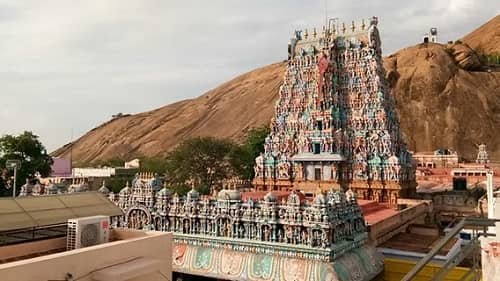
The Thiruparankundram Murugan Temple near Madurai holds a very special place in Murugan worship. It is the first of the six Arupadaiveedu (holy abodes) of Lord Murugan and marks the divine spot where Murugan married Deivayanai, the daughter of Lord Indra.
Carved directly into a rocky hill, this 8th-century cave temple feels ancient, powerful, and deeply spiritual. Unlike many Murugan temples built later with towering corridors, Thiruparankundram still carries the quiet intensity of its rock-cut origins. Inside the sanctum, Murugan appears with Deivayanai, while nearby shrines house Shiva, Vishnu, Durga, and Vinayaka — making this a rare temple where multiple deities coexist in one sacred cave complex.
Pilgrims believe that beginning Murugan worship here removes obstacles in marriage, career, and family life.
Daily Thiruparankundram Temple Timings
The temple follows a simple morning–evening schedule with a long afternoon break.
| Period | Timing |
| Morning Darshan | 5:00 AM – 1:00 PM |
| Afternoon Break | 1:00 PM – 4:00 PM |
| Evening Darshan | 4:00 PM – 9:00 PM |
Pro Tip: Arrive around 5:00 AM to witness the peaceful opening moments and early rituals before crowds build up.
Pooja and Ritual Timings
Eight daily Kalams (ritual periods) are observed:
- Thiruvanandal (Morning): 5:30 AM – 6:00 AM
- Vilaa Pooja: 7:00 AM – 7:30 AM
- Kalasandhi Pooja: 8:00 AM – 8:30 AM
- Thirukalasandhi: 10:30 AM – 11:00 AM
- Uchikkala Pooja (Midday): 12:30 PM – 1:00 PM
- Sayaraksha Pooja (Evening): 5:30 PM – 6:00 PM
- Ardhajama Pooja (Night): 8:30 PM – 9:00 PM
- Palliyarai Pooja (Closing): 9:00 PM – 9:15 PM
Unique Ritual – Vel Abhishekam
Since this is a cave temple and the main deity is carved from rock, full water abhishekam is not performed on the idol. Instead, Palabhishekam (milk ritual) is offered daily to Lord Murugan’s Vel (spear). Devotees can often witness this sacred moment inside the sanctum.
History and Architecture of Thiruparankundram Temple
Thiruparankundram dates back over a thousand years and reflects early Pandya rock-cut architecture. The sanctum, pillars, and mandapams are hewn directly from living stone, giving the temple a rare cave-shrine character.
The massive Rajagopuram rises dramatically at the entrance, while inside, the cool stone interiors carry centuries of chants and lamp smoke. One striking feature is the shrine of Lord Vishnu reclining inside the same complex — something rarely seen in Murugan temples.
This sacred hill is also associated with Skanda’s victory over Surapadman and his divine wedding, making it both a victory shrine and a marriage temple.
Best Time to Visit Thiruparankundram Murugan Temple
Ideal Season
October to March offers the most comfortable weather for Madurai travel.
Major Festivals
- Skanda Sashti (Oct/Nov): Grand six-day celebration with Surasamharam
- Panguni Uthiram (Mar/Apr): Celebrates Murugan–Deivayanai wedding
These periods draw massive crowds.
Daily Tip
Weekday mornings are calmest. Evenings after 6:00 PM are busiest.
How to Reach Thiruparankundram Temple
By Air – Nearest airport: Madurai International Airport — about 10 km away.
By Train – Madurai Junction is roughly 8 km from the temple.
By Road – Local buses, autos, and taxis run frequently from Periyar Bus Stand and all parts of Madurai city.
The temple town of Thiruparankundram is well connected and easy to reach within 20–30 minutes from central Madurai.
Tips for Visitors and Dress Code
Dress Code
Traditional clothing is strongly advised.
- Men: Dhoti or formal trousers
- Women: Saree or Salwar Kameez
Shorts and sleeveless tops are generally not allowed inside.
Helpful Tips
- General darshan is free; Special Darshan tickets (~₹100) help skip long queues
- Photography is prohibited inside the sanctum (outer areas allowed)
- Carry minimal belongings
- Visit early on festival days
- Spend a few minutes in silent prayer inside the cave — the energy feels different here
FAQs
Q. Is there an entry fee?
Ans: No, general darshan is free.
Q. How long does darshan take?
Ans: 30–45 minutes on weekdays. Festivals may take 2–3 hours.
Q. Can photos be taken inside?
Ans: No. Only outer complex photography is allowed.
Q. What makes this temple special?
Ans: It is Murugan’s first Arupadaiveedu and the site of his divine marriage to Deivayanai.