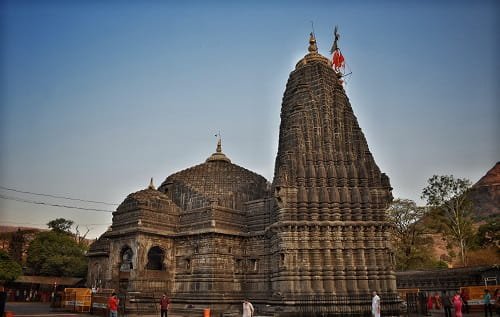
The Trimbakeshwar Shiva Temple, located near Nashik, is one of the twelve Jyotirlingas of Lord Shiva and among the most spiritually powerful shrines in India.
What makes Trimbakeshwar truly unique is its Jyotirlinga — it has three faces, symbolizing Lord Brahma, Lord Vishnu, and Lord Maheshwara together in a single sacred form. Very few temples in the country represent the Trinity this way.
Set against the backdrop of the Brahmagiri hills, the temple is also closely associated with the origin of the Godavari River. Devotees believe that visiting Trimbakeshwar brings relief from ancestral doshas, planetary afflictions, and long-standing obstacles in life.
Unlike many grand marble temples, Trimbakeshwar feels deeply ancient and grounded — black stone walls, Vedic chants, the smell of incense, and constant movement of pilgrims give it a raw spiritual energy that’s hard to describe.
Daily Trimbakeshwar Temple Timings
The temple usually remains open for around 15 hours daily.
| Activity | Timing |
| Temple Opening | 5:30 AM |
| Kakad Aarti (Morning Aarti) | 5:30 AM – 6:00 AM |
| General Darshan | 5:30 AM – 9:00 PM |
| Madhyan Pooja (Midday) | 1:00 PM – 1:30 PM |
| Evening Aarti / Pooja | 7:00 PM – 8:00 PM |
| Temple Closing | 9:00 PM |
Abhisheka and Special Ritual Timings
Certain rituals allow closer access to the Jyotirlinga and are considered highly auspicious:
- Jalabhishek / Rudrabhishek: 6:00 AM – 7:00 AM
(This is generally the only time devotees may enter the inner sanctum and touch the Linga.) - Golden Mukut (Crown) Darshan: Every Monday, 4:30 PM – 5:00 PM
(A rare display of the jewel-studded crown believed to date back to the Pandava era.)
These slots attract heavy crowds, so arriving early is essential.
History and Architecture of Trimbakeshwar Temple
The present structure was rebuilt in the 18th century by Peshwa Balaji Baji Rao, using dark basalt stone in classic Nagara architectural style.
The temple’s most striking feature is its compact sanctum housing the three-faced Jyotirlinga. Unlike other Shiva temples where the Linga rises prominently, here it sits slightly below ground level, emphasizing humility before divinity.
Nearby lies Kushavarta Kund, a sacred water tank believed to be the symbolic source of the Godavari River. Many pilgrims take a holy dip here before entering the temple, especially those performing ancestral rituals.
Trimbakeshwar is also a major center for Narayan Nagbali, Kaal Sarp Shanti, and Pitru Dosha poojas.
Best Time to Visit Trimbakeshwar Temple
Ideal Season
September to March offers pleasant weather and comfortable darshan conditions.
Peak Periods
- Mondays (weekly Shiva day)
- Shravan Month (July–August)
- Maha Shivaratri
During these times, queues can stretch for hours.
Daily Tip
Visit between 6:00 AM and 8:00 AM on weekdays for the smoothest darshan.
How to Reach Trimbakeshwar Temple
By Air – Nearest airport: Nashik Airport (about 40 km).
By Train – Nashik Road Railway Station is the closest major railhead. From there, taxis and buses reach Trimbakeshwar in about 1 hour.
By Road – Trimbakeshwar is around 28 km from Nashik city. MSRTC buses, shared jeeps, and private taxis run frequently.
Important Visitor Guidelines & Dress Code
Dress Code
General Darshan:
Modest traditional clothing is strongly recommended.
- Men: Dhoti/Kurta or formal trousers
- Women: Saree or Salwar Kameez
Shorts and sleeveless tops are discouraged.
Inner Sanctum / Special Pooja:
- Men must wear white dhoti and towel only (no shirt or vest).
- Women must wear saree or traditional suit.
Other Rules
- Mobile phones and cameras are strictly prohibited inside
- Cloakrooms are available near the entrance
- Footwear must be removed before entering
Darshan Tips
- Sheegra (VIP) Darshan: Available for approx. ₹200 if queues are long
- Bookable at temple counters or official trust site
- Take a holy dip at Kushavarta Kund before darshan if time permits
- Mondays and Shravan month require extra patience
FAQs
Q. How long does darshan take?
Ans: Weekdays: 45–60 minutes.
Weekends/festivals: 3–5 hours.
Q. Is photography allowed?
Ans: No. Phones and cameras are banned inside the temple.
Q. Are lockers available?
Ans: Yes, cloakrooms are provided for footwear and electronics.
Q. When can devotees touch the Linga?
Ans: Usually during Jalabhishek (6:00 AM – 7:00 AM), subject to crowd control.