Veneer finish vs PU finish isn’t quite an either-or choice, because most veneered furniture in India is itself sealed with a clear PU coat. The real question is what you want to see on the surface. A veneer finish shows real wood: the grain of walnut, the golden streaks of teak or the open pores of oak, protected under a transparent polish. An opaque PU finish hides the board completely beneath a solid layer of colour, from soft greige to deep emerald or glossy white. One celebrates natural material, the other celebrates colour and form. Each suits different rooms, styles and budgets in Indian homes.
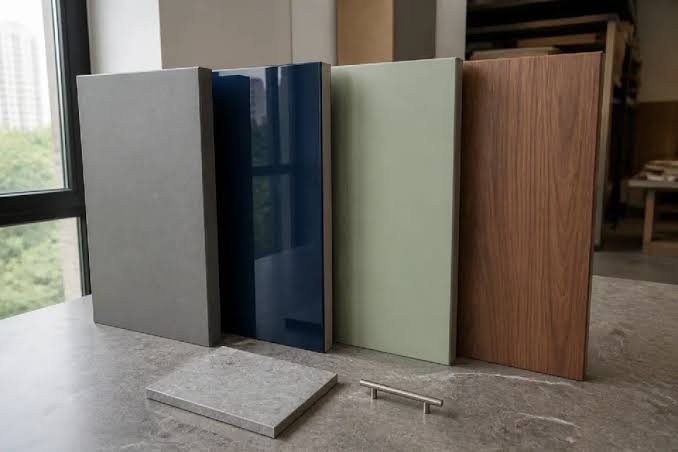
Wood Grain or Solid Colour
Veneer is a thin slice of natural timber pressed onto plywood, MDF or blockboard. After pressing, it’s sanded and finished with a clear coat that brings out the grain and protects it. No two sheets are identical, which gives veneered surfaces a natural, crafted character.
Opaque PU finish is a pigmented polyurethane paint sprayed over a smooth base board, usually MDF or HDHMR. It creates a uniform, seamless surface in practically any shade, with sheen levels from deep matte to mirror-like gloss.
How Each Looks Under Indian Light and Life
Warmth and Character
Veneer brings instant warmth. Under warm-white lights in the evening, teak, walnut and oak veneers glow richly and make living rooms and bedrooms feel inviting. Smoked, fumed and dyed veneers add even more variety, from ash grey to near-black.
Opaque PU brings a crisp, modern presence. It gives clean lines, bold colour and a sculpted look that suits contemporary apartments and minimalist interiors.
Consistency Across Large Areas
PU is uniform. A wardrobe, a TV unit and a kitchen can share exactly the same shade across the home.
Veneer varies naturally from sheet to sheet. For large areas like a full-height wall panel or a run of wardrobe shutters, ask your carpenter to use sheets from the same bundle, cut in sequence from one log. Numbering the sheets in order before pressing keeps the grain flowing smoothly across panels, a detail that separates average veneer work from excellent work.
Ageing Gracefully
Natural wood evolves. Teak veneer deepens to a honeyed tone, walnut mellows and cherry warms up over the years. Many homeowners enjoy this patina as part of the charm.
Opaque PU holds its applied colour, which suits interiors where a precise shade matters, such as a colour-matched kitchen or a feature wall coordinated with upholstery.
Moisture-Prone Zones
Opaque PU on HDHMR handles kitchens and bathroom vanities comfortably when well applied. Veneer with a quality PU clear coat also works in kitchens, though areas right beside the sink and hob benefit from extra care with wiping and sealing.
Picking the Right Polish for Veneer
The clear coat on veneer shapes how it looks and how long it lasts.
- Melamine polish: economical with a pleasant satin look; best for low-moisture areas like bedroom wardrobes and panelling.
- Clear PU: tougher, more water-resistant and available from matte to high gloss; the preferred choice for tables, kitchens and doors.
- NC lacquer: quick-drying with a smooth finish, often used in factory-made furniture.
- Natural oil or hard wax: a raw, tactile look that shows the wood’s texture; needs periodic re-oiling.
You can also choose between open-pore finishes, where you can feel the grain, and closed-pore finishes, where the pores are filled for a glass-smooth surface.
Cost of a Feature Wall
Take an 8 ft × 10 ft TV or bedroom feature wall, 80 square feet in all, using approximate 2026 market rates.
For a veneer finish:
- Mid-range veneer at around ₹200 per square foot
- Clear PU polish at around ₹150 per square foot
- 12 mm plywood base at around ₹70 per square foot
That totals about ₹420 per square foot, or roughly ₹33,600 for the wall.
For an opaque PU finish on HDHMR at a mid-range rate of around ₹600 per square foot, the same wall comes to roughly ₹48,000.
So veneer isn’t always the costlier option. With basic or mid-range species, it can work out lower than multi-coat opaque PU. Premium veneers like American walnut or figured species, which can cost ₹400 or more per square foot, shift the balance the other way.
Matching the Finish to Your Interior Style
For warm traditional and Indian contemporary homes, veneer fits naturally alongside brass fittings, jaali work and handloom textiles. Teak and sheesham-toned veneers echo classic Indian furniture.
For Scandinavian and Japandi-inspired interiors, light oak, ash and maple veneers with matte clear finishes create a calm, natural feel.
For modern minimalist apartments, opaque PU in soft neutrals or muted pastels gives clean, handle-less surfaces that keep the space light.
For bold, colour-led designs, opaque PU is the clear winner, allowing navy kitchens, green bar units or terracotta wardrobes.
Many designers combine the two. Veneer panelling behind the bed or TV paired with opaque PU wardrobes or kitchen shutters adds warmth and colour in balance.
Planning Tips
- View full veneer sheets in person before approving, rather than small samples.
- Ask for sequence-matched sheets for large continuous surfaces.
- Choose clear PU over melamine for any veneer surface that will be touched or wiped often.
- For opaque PU, prefer factory-sprayed panels for a smoother, harder finish.
- See painted PU samples under your home’s actual lighting.
- Keep leftover veneer offcuts or the PU shade code for future repairs.
FAQs
Q1. Which is better for interiors, veneer or PU finish?
A: Veneer suits interiors that celebrate natural wood, while opaque PU suits modern designs that need solid colours and seamless surfaces.
Q2. Is veneer polished with PU?
A: Yes, veneer is often sealed with clear PU polish to protect the wood and enhance its grain.
Q3. Is veneer finish more expensive than PU?
A: Not always; mid-range veneer with clear polish can cost less than multi-coat opaque PU, though premium species cost more.
Q4. Can veneer be used in kitchens?
A: Yes, veneer with a good clear PU coat works in kitchens, with extra care near the sink and hob.
Q5. Does veneer change colour over time?
A: Yes, natural wood veneers slowly deepen or mellow, developing a pleasing patina.
Q6. Which finish is easier to repair?
A: Both can be refreshed; veneer can be lightly sanded and re-polished, while PU panels can be resprayed.