Delhi-NCR’s air quality index regularly crosses “severe” territory every winter, and even quieter cities like Bengaluru and Mumbai see PM2.5 levels well above WHO safe limits on any given day with heavy traffic or construction nearby. An air purifier under ₹15,000 can genuinely clean a bedroom or living room, but only if you pick one with a real True HEPA filter and a CADR (Clean Air Delivery Rate) that actually matches your room size — many budget listings quote “maximum coverage” figures that assume near-ideal conditions rarely found in Indian homes. Here are ten models worth considering as of September 2026, based on filtration grade, CADR, noise levels and long-term filter costs.
| Purifier | Price (Approx.) | CADR | Coverage | Filtration | Noise (Low/High) |
| Philips AC1215/2000 Series | ₹12,999–₹14,999 | ~350–400 m³/h | Up to 550 sq ft | NanoProtect True HEPA + activated carbon | Quiet on low |
| Xiaomi Smart Air Purifier 4 | ₹10,999–₹13,999 | 380 m³/h | Up to 484 sq ft | 3-layer True HEPA H13 + carbon | ~34–64 dB |
| Coway Airmega AIM | ₹10,000–₹12,000 | 303 m³/h | ~355 sq ft | 3-stage: pre-filter, True HEPA, deodorization | 20–52 dB |
| Honeywell Air Touch V4 | ₹10,000–₹13,000 | 300 m³/h | 465 sq ft | True HEPA + activated carbon | Under 50 dB |
| Philips AC0820/20 | Under ₹8,000 | ~130 m³/h | Small-mid rooms | NanoProtect HEPA | Under 49 dB |
| CUCKOO (compact True HEPA model) | ₹9,000–₹14,000 | Varies by model | 355–570 sq ft | True HEPA H13, some with copper infusion | Quiet (BLDC motor) |
| Sharp Air Purifier (HEPA range) | ₹10,000–₹14,500 | ~240–300 m³/h | Mid-size rooms | True HEPA + Plasmacluster ion technology | Quiet mode available |
| Qubo (Hero Group) Smart Purifier | ₹8,000–₹13,000 | ~250 m³/h | Mid-size rooms | True HEPA + carbon, app/voice control | Moderate |
| Mi Air Purifier 3 | ₹9,000–₹11,000 | 360 m³/h | Up to 516 sq ft | 3-layer H13 HEPA + carbon | Quiet on auto mode |
| Budget 4-stage HEPA + UV model with AQI display | ~₹5,699 | Lower CADR, small rooms | Compact spaces | HEPA + UV + real-time AQI monitor | Low noise |
Prices, CADR and coverage figures are approximate as of September 2026 and vary by retailer, festival sale and exact model variant — always verify current specs on the brand’s own listing before buying.
The Ten Purifiers in Detail
1. Philips AC1215/2000 Series
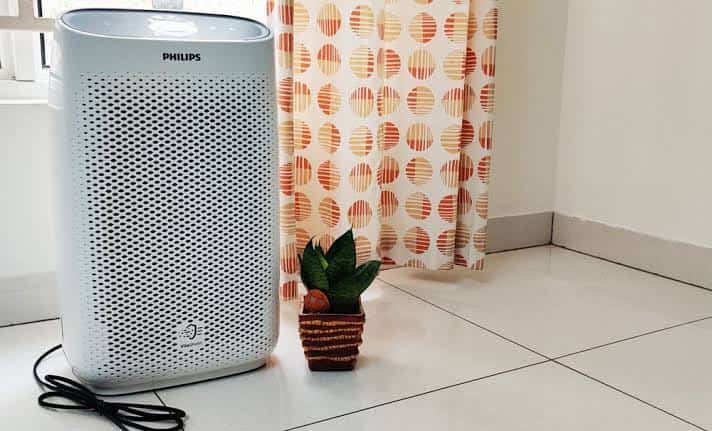
— Philips’ proprietary NanoProtect HEPA media, rather than an off-the-shelf glass-fibre filter, pairs with genuinely quiet low-mode operation. Strong overall pick backed by Philips’ wide Indian service network, making warranty claims and filter sourcing straightforward.
2. Xiaomi Smart Air Purifier 4
— Strong app integration through Mi Home, with real-time AQI monitoring and voice control support. A 3-layer True HEPA H13 filter with carbon handles dust and odours well, and its 380 m³/h CADR is impressive relative to the price.
3. Coway Airmega AIM
— Built around Coway’s long-standing reputation for filter quality and very low noise on its quietest setting, making it a favourite for bedrooms. Coway also backs its purifiers with an industry-leading multi-year motor warranty.
4. Honeywell Air Touch V4
— A dependable mid-range option with a wider coverage footprint than many rivals at this price, suiting bigger bedrooms or a small living room. Honeywell’s durability reputation in India adds confidence for long-term use.
5. Philips AC0820/20
— The most affordable genuine Philips option here, with cheap replacement filters (around ₹1,500) and quiet sub-49 dB operation. Best suited to a compact bedroom or study rather than a full living room.
6. CUCKOO True HEPA Range
— Some CUCKOO models weave elemental copper directly into the HEPA H13 filter for added antibacterial action, alongside a quiet BLDC motor. A distinctive filtration approach worth considering for households prioritising hygiene alongside particle capture.
7. Sharp Air Purifier (HEPA range)
— Combines True HEPA filtration with Sharp’s Plasmacluster ion technology, aimed at tackling odours and airborne bacteria beyond what carbon and HEPA alone manage. A reasonable pick for kitchens or odour-prone rooms.
8. Qubo (Hero Group) Smart Purifier
— Brings a smart-home feel with app and voice control from an Indian brand backed by the Hero Group. True HEPA plus carbon filtration covers the essentials for a mid-size bedroom or living room.
9. Mi Air Purifier 3
— Punches above its price with a 3-layer H13 HEPA filter, activated carbon and Mi Home app connectivity for real-time AQI tracking. Replacement filters cost around ₹1,200, keeping ongoing costs low.
10. Budget 4-stage HEPA + UV model
— The most wallet-friendly genuine option on this list, adding a UV stage and live AQI display to standard HEPA filtration. Best matched to a small bedroom or study under roughly 150–200 sq ft rather than a larger room.
What to Actually Check Before Buying
- CADR is more important than the “coverage area” printed on the box. A simple formula many reviewers use: multiply your room’s area in square feet by 1.5 to get the minimum CADR you should look for, since Indian pollution levels are typically higher than the conditions these ratings are tested under.
- Insist on “True HEPA” or a specific grade like H13, not a vague “HEPA-type” or “HEPA-style” filter, since the latter often means a lower-grade filter that doesn’t meet the same particle-capture standard.
- Check noise level on sleep or low mode specifically, since a purifier that’s too loud on its effective setting will either keep you awake or get switched off — defeating the purpose.
- Factor in filter replacement cost, typically ₹1,200–₹2,500 a year depending on the brand, since this recurring cost matters more over three to five years than the purchase price alone.
- A room with open windows won’t benefit from any purifier, regardless of CADR, since the unit needs a closed space to actually reduce particle concentration.
Frequently Asked Questions
Q1. Is a higher CADR always better, even for a small room?
Not necessarily useful beyond a point — matching CADR to your actual room size gets you the recommended air changes per hour without overpaying for capacity you don’t need, so calculate based on your room’s square footage rather than simply buying the highest number available.
Q2. How often do I actually need to replace the HEPA filter in Indian conditions?
Most manufacturers recommend replacement every 6–12 months for the pre-filter and roughly annually for the True HEPA filter under typical Indian pollution and usage, though heavy-pollution cities like Delhi may need more frequent changes — check your specific model’s indicator light or the manufacturer’s guidance rather than guessing.
Q3. Does an air purifier help with monsoon humidity or musty odours, not just dust and smoke?
A good activated carbon layer helps reduce odours including some mold-related smells, but a purifier doesn’t control humidity itself, so pairing it with a dehumidifier in particularly damp rooms gives better results during monsoon months.
Q4. Can I use one purifier for my whole home instead of buying separate units for each room?
Generally no — CADR and coverage ratings are calculated for a single enclosed room, so moving one unit between rooms or trying to cover an entire home with it will significantly underdeliver on air changes per hour compared to using appropriately sized units in each frequently used room.