Pachmarhi is Madhya Pradesh’s only hill station and one of Central India’s most rewarding and undervisited destinations — locally known as Satpura Ki Rani, the Queen of the Satpura Hills, this forested plateau in the Satpura Range of the Narmada valley sits at 1,067 metres elevation in Hoshangabad district, offering a completely different character from both the Himalayan hill stations of the north and the coastal destinations of the south. Famous for the Bee Falls — a 35-metre cascade through thick forest that is the finest waterfall in Central India — the Dhupgarh summit at 1,352 metres which is the highest point in Madhya Pradesh and offers the most dramatic sunset and sunrise in the region, the Jata Shankar Caves where natural rock formations resemble the matted locks of Lord Shiva, the Pandav Caves — five ancient rock-cut shelters associated with the Mahabharata — the Apsara Vihar natural swimming pool, and the Satpura Tiger Reserve that covers the surrounding protected forest, Pachmarhi combines natural beauty, archaeological heritage, wildlife habitat, and a year-round pleasant climate into a destination that consistently surprises visitors who expected less. Whether you are planning a family hill station holiday, a nature trekking expedition, a wildlife safari in the Satpura Tiger Reserve, a waterfall and cave exploration circuit, or simply an unhurried escape to a green, quiet mountain plateau, choosing the best time to visit Pachmarhi shapes both the character and the comfort of your experience.
Pachmarhi Travel Overview
| Factor | Details |
| Best Overall Time | October to March |
| Peak Tourist Season | October to January and April to June |
| Cheapest Time to Visit | July to September |
| Best for Waterfalls | July to September |
| Best for Sightseeing | October to March |
| Best for Honeymoon | October to February |
| Best for Families | October to March and April to June |
| Best for Wildlife | October to April |
| Best for Budget Travelers | July to September |
| Average Temperature | 4°C to 35°C (varies by season) |
Why Timing Matters When Visiting Pachmarhi
Pachmarhi’s elevated plateau location moderates its temperatures relative to the surrounding Madhya Pradesh plains year-round — it is genuinely cool in winter, comfortably warm rather than oppressively hot in summer, and receives moderate but meaningful monsoon rainfall that creates its lush forested character. Unlike India’s major hill stations which have dramatic seasonal extremes, Pachmarhi is often described as a year-round destination — and this is largely true, with the caveat that the monsoon months bring restrictions on some trekking and cave access while delivering the most dramatically beautiful waterfall season.
The right timing depends on whether you prioritise comfortable sightseeing temperatures, the finest waterfall experiences, wildlife safari access, or the most affordable rates.
Visiting Pachmarhi During Winter (October to February)
Winter is the most popular and most broadly recommended time to visit Pachmarhi — the cool, clear conditions make full-day sightseeing genuinely comfortable, all attractions and trekking routes are fully accessible, and the cultural calendar includes the Pachmarhi Utsav that brings the state’s finest cultural programming to this plateau destination.
Weather During Winter
Temperatures range between 4°C and 25°C — pleasant sunny days with comfortably cool evenings. December and January are the coldest months with early mornings occasionally dropping toward 4°C to 8°C. Days are consistently bright and clear with low humidity, creating ideal conditions for photography and outdoor exploration.
Why Visit Pachmarhi in Winter?
- All major attractions — Bee Falls, Dhupgarh, Jata Shankar, Pandav Caves, Apsara Vihar, and all viewpoints — are fully accessible in comfortable winter temperatures
- Dhupgarh sunset and sunrise are at their most spectacular in winter’s clear, unpolluted atmosphere — the view from Madhya Pradesh’s highest point across the forested Satpura valleys is most dramatic in the transparent winter air
- Pachmarhi Utsav — the state tourism department’s premier cultural festival — is held in December, bringing folk performances, classical music, artisan displays, and the Satpura Mahotsav dance and music festival
- Wildlife sightings in the Satpura Tiger Reserve improve through winter as vegetation thins and animals concentrate at water sources — tiger, leopard, gaur, wild dog, and sloth bear sightings are most productive from November to April
- Bee Falls — while not at monsoon peak flow — continues flowing beautifully through the cool winter months with the clearest water quality and the most comfortable approach conditions
- Trekking to Handi Khoh (the Devil’s Ravine) and the Chauragarh Temple is most pleasant in the cool winter air
Winter is the most complete and most comfortable season for the full Pachmarhi circuit.
Best Places to Visit
Dhupgarh
Madhya Pradesh’s highest point at 1,352 metres — the sunset view from the Dhupgarh summit across the forested Satpura landscape to the horizon is the single finest viewpoint experience in Central India, most dramatically clear under winter skies when the atmosphere is at its most transparent.
Bee Falls (Rajat Prapat)
The 35-metre cascade through dense forest — accessed by a 1-kilometre walk from the road — flows consistently year-round with the clearest water quality in winter months. The approach path is most safely and pleasantly navigated in the dry winter conditions.
Jata Shankar Caves
This natural cave system where rock formations resemble the matted dreadlocks of Lord Shiva is most comfortably explored in winter temperatures — the cave’s natural cool interior and the approach trail through the forest are both most pleasant when the ambient temperature is already cool.
Pandav Caves
Five ancient rock-cut shelters on a plateau above the main town, traditionally associated with the Pandavas’ exile in the Mahabharata, are most atmospheric in winter morning light when the surrounding plateau is still in low morning sunlight.
Satpura Tiger Reserve Safari
The winter season from November to April provides the finest wildlife safari experience in the Satpura Tiger Reserve, which shares its landscape with Pachmarhi and is accessible via canoe and jeep safaris from the Madhai entry point.
Advantages of Winter Travel
- Best temperatures for all-day sightseeing and trekking
- All attractions and trails fully accessible
- Pachmarhi Utsav cultural festival in December
- Wildlife safari conditions most productive
- Clear skies deliver finest photography at Dhupgarh and all viewpoints
Disadvantages
- December and January peak brings significant domestic tourist crowds
- Pachmarhi Utsav week requires advance hotel booking
- Early mornings at 4°C to 8°C require warm layers for outdoor activity
October and November — The Finest Post-Monsoon Window
October and November represent a uniquely rewarding travel window that many experienced visitors consider the very finest months of all — the monsoon has just retreated, the entire plateau and surrounding forest are at maximum vivid green, waterfalls are still flowing with strong post-monsoon reserves, and the first comfortable winter temperatures have arrived without the December-January tourist surge.
What Makes October and November Special?
- The forest is at its most vivid and intensely green — the full botanical richness of the monsoon season preserved while the rain itself has stopped
- Waterfalls including Bee Falls and Silver Falls are still flowing with good monsoon-reserve volume
- Hotel rates are below the December-January peak
- All tourist routes and trekking trails are clear and accessible
- Diwali celebrations in October or November add a festive dimension to the region’s cultural life
- Wildlife in Satpura Tiger Reserve is highly active in the post-monsoon transition
Visiting Pachmarhi During Summer (March to June)
Summer in Pachmarhi serves a specific and important purpose in Central India’s travel geography — it provides a cool, forested mountain refuge from the intense heat that grips Bhopal, Indore, Nagpur, and the surrounding Madhya Pradesh plains during April, May, and June when temperatures can reach 45°C.
Weather During Summer
Temperatures range between 22°C and 35°C — significantly cooler than surrounding plains cities, with cool breezes at Dhupgarh and the forest areas moderating even the warmest days. The Pachmarhi plateau’s elevation and dense forest cover keep temperatures manageable throughout the day.
Why Visit Pachmarhi in Summer?
- Pachmarhi functions as an essential cool-weather escape when the surrounding plains are at their most extreme — the 10 to 15 degree temperature difference from Bhopal or Nagpur is immediately and physically apparent
- The natural swimming pools — Apsara Vihar, Duchess Falls pool, and the pools at Bee Falls — are most actively used and most enjoyed in the warm summer conditions
- All viewpoints, caves, and sightseeing circuits are fully operational
- Summer is when Pachmarhi is most popular with domestic tourists from Central India’s cities
- The forest wildlife is concentrated near water sources in summer heat — sloth bears, gaur, and deer are regularly sighted near the plateau’s natural water bodies
Best Summer Activities
- Natural swimming at Apsara Vihar and the falls pool areas
- Dhupgarh sunrise viewing in the cool pre-dawn temperatures
- Forest trekking in the early morning hours before midday heat
- Jata Shankar Cave exploration — the cave’s natural interior remains cool
- Chauragarh Temple trek — a significant Shiva pilgrimage destination reached by a 5-kilometre forest trail from Mahadeo
Benefits of Summer Travel
- The most complete Cool Central Indian Escape from the plains’ extreme heat
- Natural swimming pools at their most popular and most refreshing
- All sightseeing circuits fully accessible
- Pachmarhi’s forested plateau provides genuinely cooler conditions than any plains alternative
Drawbacks
- April and May afternoons can be warm at 30 to 35°C — midday outdoor activity requires planning
- April to June brings the largest tourist crowds from Central India
- Some trekking trails can be warm and dusty without the monsoon’s freshness
Visiting Pachmarhi During Monsoon (July to September)
Monsoon transforms Pachmarhi into one of Central India’s most dramatically beautiful natural landscapes — a forested plateau where every waterfall runs at maximum power, the dense Sal and teak forest deepens to an extraordinary green, and the mist and cloud patterns through the Satpura valleys create photography conditions of genuine distinction.
Weather During Monsoon
Temperatures range between 18°C and 28°C — genuinely cool and refreshing. Rainfall is regular and sometimes heavy from July to September, with August typically the wettest month. The Satpura range receives moderate but meaningful monsoon rainfall — enough to create the waterfall spectacle without the extreme rainfall of the Western Ghats or Northeast India.
Why Visit Pachmarhi During Monsoon?
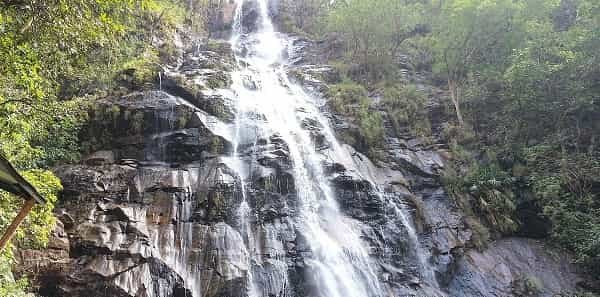
- Bee Falls — Pachmarhi’s signature attraction — is at its most powerful and visually dramatic in monsoon with the full volume of monsoon rainfall cascading 35 metres through dense green forest
- Silver Falls, Apsara Vihar, Duchess Falls, and a dozen smaller cascades scattered across the plateau all run at maximum volume simultaneously — the waterfall diversity in monsoon Pachmarhi is extraordinary
- The Satpura forest is at its most vivid, lush, and botanically rich — a dense green canopy covering the entire plateau
- Mist-filled valleys photographed from Dhupgarh and Forsyth Point create landscape images of exceptional atmospheric quality
- Hotel rates are at their lowest — some properties offer 30 to 50 percent discounts from winter peak rates
- The UNESCO Biosphere Reserve aspect of Satpura is most beautifully expressed in the monsoon green
Popular Monsoon Attractions
Bee Falls in Monsoon
The 35-metre cascade runs with the full power of monsoon rainfall — the volume of water is dramatically greater than the year-round trickle and the surrounding forest is at its most impossibly green. The approach path through the monsoon forest is wet and slippery but enormously beautiful.
Forsyth Point in Rain
Named after Captain James Forsyth who first described Pachmarhi to the British authorities, this viewpoint above the plateau edge offers dramatic views across the misty Satpura valleys — most atmospheric in monsoon when rising mist and cloud formations create a constantly changing visual landscape.
Sunset Point in Monsoon Clouds
The dramatic sunset view from Pachmarhi’s western rim takes on an entirely different quality in monsoon — orange sunset light breaking through monsoon cloud layers over the forested valleys below creates colour effects unique to this season.
Advantages of Monsoon Travel
- Waterfalls at absolute maximum power and visual drama
- The Satpura forest at its most lush and intensely green
- Lowest accommodation rates of the year
- Mist and cloud photography of exceptional quality
- Fewer tourists create a more peaceful, authentic experience
Disadvantages
- Some trekking trails become slippery and potentially dangerous in heavy rain
- Road conditions can deteriorate on access roads during sustained heavy rainfall
- Some cave visits — particularly Jata Shankar where water seeps through rock — are restricted during peak monsoon
- Wildlife safaris in Satpura Tiger Reserve are restricted during the monsoon core season
- Outdoor dining and extended sightseeing require flexibility around rain showers
Best Time to Visit Pachmarhi for Different Travellers
For Honeymooners
October to February offers the most romantic combination of cool forested evenings, dramatic Dhupgarh sunsets, cosy cottage accommodation, and the intimate atmosphere of a hill station that remains significantly less commercialised than its Himalayan counterparts.
For Families
October to March provides comfortable temperatures for all ages, all caves, falls, and viewpoints accessible, and the Pachmarhi Utsav cultural activities in December creating memorable family experiences.
For Budget Travellers
July to September for the lowest accommodation rates — the waterfall spectacle at Bee Falls and the extraordinary monsoon green landscape compensate significantly for the rain disruption risk.
For Wildlife Enthusiasts
November to April for the Satpura Tiger Reserve — accessible by canoe-and-jeep safari from Madhai on the reserve’s boundary, this is one of India’s least crowded and most rewarding tiger reserves with excellent sighting records.
For Photographers
October and November for the finest combined conditions — post-monsoon green, clear skies, still-flowing waterfalls, and the most atmospheric mist patterns in the valleys. July for the most dramatic waterfall photography.
Best Time for Dhupgarh Sunrise and Sunset
Dhupgarh is Pachmarhi’s most famous and most visited single attraction.
Ideal Months
October to March for the clearest and most dramatic views.
Dhupgarh experiences include:
- Sunrise at 1,352 metres — the earliest light illuminating the Satpura forest canopy below
- Sunset view across the western horizon — rated one of the finest sunset viewpoints in Central India
- Clear winter atmosphere allows views extending 50 to 80 kilometres on the finest days
- Monsoon sunsets are dramatically coloured through cloud layers but visibility is limited
- The 4-kilometre approach road from Pachmarhi town allows vehicle access to within easy walking distance
Festivals and Events in Pachmarhi
Pachmarhi Utsav
Held every December, this premier cultural festival organised by the Madhya Pradesh Tourism Development Corporation features classical music and dance performances, tribal art exhibitions, adventure sports demonstrations, and the Satpura Mahotsav folk arts programme. The combination of Pachmarhi’s natural beauty in December’s clear weather with this rich cultural programme creates one of Central India’s finest travel events.
Shivratri Fair at Chauragarh
The Chauragarh Temple atop a 1,326-metre peak accessible by a steep 5-kilometre forest trail is among Madhya Pradesh’s most significant Shiva shrines. On Maha Shivratri in February or March, hundreds of thousands of devotees make the steep pilgrimage climb in one of Central India’s most extraordinary religious events — a spectacle that rewards the curious observer as much as the devout pilgrim.
Navratri Celebrations
October’s Navratri brings nine nights of devotional music, cultural programmes, and community celebrations to Pachmarhi and the surrounding villages — a festive dimension to the October visit that combines the finest post-monsoon landscape with an active local cultural calendar.
Travel Tips for Visiting Pachmarhi
To make your Pachmarhi trip most rewarding, consider these practical guidelines:
- Book December Pachmarhi Utsav period accommodation at least 3 to 4 weeks in advance — the festival draws significant visitor numbers and well-located properties fill quickly.
- An all-in-one Pachmarhi sightseeing ticket covering major attractions reduces administrative hassle — available at the MP Tourism desk.
- The Bee Falls approach path becomes genuinely slippery in monsoon — proper footwear with grip is essential for monsoon visits.
- Hire a Madhya Pradesh Tourism-registered guide for the forest treks and cave explorations — the additional context and historical knowledge significantly enriches the experience.
- Satpura Tiger Reserve safaris (Madhai zone) must be booked through the forest department in advance — the canoe-and-jeep safari combination is the most distinctive wildlife experience in Central India.
- Pachmarhi is reached from Bhopal (190 kilometres, approximately 5 hours) or Itarsi railway junction (47 kilometres, 1.5 hours) — Itarsi is well-connected to both Delhi and Mumbai by major trains.
- The roads within Pachmarhi town are steep and narrow — explore by foot, cycle, or auto-rickshaw rather than private vehicle for the most rewarding town experience.
Conclusion
The best time to visit Pachmarhi is from October to March — the winter season when temperatures are most comfortable for full-day sightseeing across the plateau’s extraordinarily rich circuit of waterfalls, caves, viewpoints, and forest trails, the Pachmarhi Utsav creates a cultural dimension to the December visit, and wildlife safaris in Satpura Tiger Reserve are at their most productive.
October and November stand out as the finest individual months — post-monsoon green at its most vivid, waterfalls still flowing with monsoon reserves, clear skies delivering the finest Dhupgarh panoramas, and hotel rates below the December-January peak with minimal crowds.
Pachmarhi is one of India’s most genuinely underrated destinations — Central India’s only hill station, a UNESCO Biosphere Reserve, the site of significant archaeological heritage, home to Madhya Pradesh’s finest waterfall, and the gateway to one of India’s most rewarding and least commercialised tiger reserves. It rewards visitors who discover it with experiences that no better-known hill station can replicate.
Frequently Asked Questions
Q1. What is the best month to visit Pachmarhi?
A: October and November for the finest overall experience — post-monsoon green landscape, still-flowing waterfalls, clear Dhupgarh views, minimal crowds, and pre-peak-season hotel rates create the most rewarding version of Pachmarhi.
Q2. What is Pachmarhi famous for?
A: Bee Falls (Rajat Prapat) — the finest waterfall in Central India, Dhupgarh — Madhya Pradesh’s highest point with extraordinary sunset views, Jata Shankar Caves, Pandav Caves, and access to the Satpura Tiger Reserve.
Q3. Is Pachmarhi worth visiting in monsoon?
A: Yes — specifically for waterfall lovers. Bee Falls and the dozen other cascades across the plateau are most dramatically powerful in July to September. The Satpura forest’s green intensity in monsoon is extraordinary. Trekking flexibility is required due to slippery paths.
Q4. What is the Pachmarhi Utsav?
A: An annual cultural festival held in December by Madhya Pradesh Tourism featuring classical music and dance performances, folk art exhibitions, adventure activities, and the Satpura Mahotsav programme — the finest cultural event in Central India’s hill station calendar.
Q5. How many days are enough for Pachmarhi?
A: A 2 to 3-day visit covers Bee Falls, Dhupgarh, Jata Shankar Caves, Pandav Caves, Apsara Vihar, and the main viewpoints comfortably. Extend to 4 to 5 days to include a Satpura Tiger Reserve safari from Madhai and the Chauragarh Temple trek.