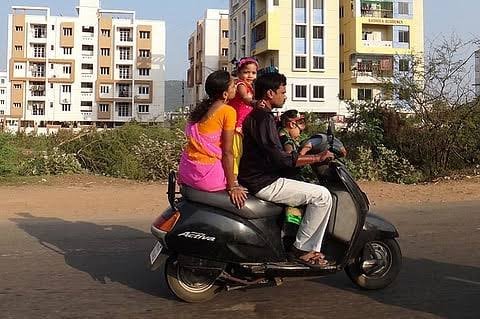
Is carrying three riders on a bike legal in India? No: Section 128 of the Motor Vehicles Act, 1988 allows a motorcycle to carry only one person besides the driver, and Section 194C, as amended in 2019, penalises a violation with a ₹1,000 fine and a three-month disqualification of the driving licence, with state fines varying. A parent holding a small child between two adults isn’t an exception the law spells out, so the safest answer is that tripling is an offence however short the trip. This is general information, not legal advice.
The Law in a Few Lines
- Rule: a two-wheeled motorcycle shall not carry more than one person in addition to the driver, under Section 128(1)
- Penalty: ₹1,000 and disqualification of the licence for three months, under Section 194C
- Helmets: both rider and pillion must wear BIS-standard helmets, under Section 129, with a separate penalty under Section 194D
- Who gets fined: the rider, and in some states the pillions as well
- How you’re caught: traffic police on the road and e-challans from CCTV cameras
What Section 128 Requires
The text is short.
- Only two people, including the driver, can sit on a two-wheeled motorcycle, and the second person must sit on a proper seat securely fixed to the motorcycle, according to Nyaaya, citing Section 128(1)
- The pillion has to sit facing forward with working footrests, according to SignalPe’s summary of CMVR Rule 138
- A scooter isn’t excused, because the sources treat two-wheelers generally
The Penalty Under Section 194C
The 2019 amendment raised the cost.
- Section 194C prescribes punishment for contravention of Section 128, with a fine of ₹1,000 and three months’ disqualification of the offender’s driving licence, according to Testbook’s explainer
- It followed the Motor Vehicles (Amendment) Act, 2019, which enhanced penalties to improve road safety
- ICICI Lombard’s guide cites Section 128(1) read with Section 177 for the fine, and the sources use both labels, so the challan may cite either
- Subsequent offences are described as ₹1,000 again, according to the same insurer’s page
Fines Differ by State
Local figures vary.
- Delhi charges ₹1,000 and Karnataka ₹500, according to Nyaaya’s older page
- A Tata AIG list gives Telangana ₹1,200, Arunachal Pradesh ₹2,000, Himachal Pradesh ₹1,000 to ₹1,500, and Uttar Pradesh ₹100, though that list is about three years old and the Uttar Pradesh figure looks outdated
- In states such as Delhi and Maharashtra, both the rider and the pillions can be fined ₹1,000, and the bike may be seized for a period, according to Acko
- Check your state’s current challan schedule before assuming a figure
The Licence Disqualification
It’s the part riders overlook.
- Disqualification for three months means you can’t hold a driving licence for that period, according to Nyaaya
- In practice the licensing authority orders it after the offence, and several guides describe it as a possible consequence, with community service in some places, according to Tata AIG
- Repeated offences can lead to licence suspension and possibly impounding of the vehicle, according to ICICI Lombard
Helmets Add to the Bill
Triple riding rarely comes alone.
- Driving without a helmet carries ₹1,000 and three months’ disqualification under Section 194D, according to Spinny
- If triple riding is accompanied by other violations, each attracts its own penalty, according to SBI General, so a helmetless tripled ride can mean two sets of fines
- A pillion without a BIS-certified helmet can also be fined ₹1,000, according to Acko
What About Children?
The rules are less clear than people assume.
- A child aged nine months to four years needs a helmet, a safety harness and a maximum speed of 40 km/h, according to Spinny
- That rule describes how a small child may travel as the one pillion, not as a third rider
- SignalPe says children under four shouldn’t be carried as pillion at all, as an advisory in many states, which sits awkwardly with the harness rule
- I found no sourced provision that excuses a small child from the one-pillion limit, so counting on a child not being “a person” is risky
- Some officers may let a family pass with a small child, but that’s discretion, not law
How You Get Caught
Enforcement has changed.
- Traffic police stop riders and check documents, according to HDFC Ergo
- Traffic CCTV cameras can capture the offence, read the number plate and issue an e-challan, according to the same source
- A challan at home arrives with a deadline, and unpaid ones can block services such as vehicle transfer
Insurance Consequences
The financial risk goes beyond the fine.
- Insurers may consider triple riding an unsafe practice, which can hamper your bike insurance, according to ICICI Lombard
- If you’re in an accident while tripling, the insurer may dispute or reduce a claim, and the other party’s lawyers will mention it
- The sources don’t say how a specific claim would be treated, so check your policy wording
Why the Law Sits Where It Does
The reasons are mechanical.
- Triple riding reduces balance, limits vehicle control and adds pressure on braking and handling, according to SBI General
- Bikes are designed for two, and the extra weight changes how they stop and turn
- Injuries in a fall are worse when three people are thrown
Triple Riding Versus Overloading
They’re different categories.
- Triple riding is limited to two-wheelers, while passenger overloading applies to four-wheelers and goods carriers, according to Tata AIG
- So the fine for a car with too many passengers falls under a separate provision
What To Do Instead
Practical alternatives exist.
- Take two trips, or use a second vehicle
- Use a cab, auto-rickshaw or public transport for the third person
- For children, plan a family journey in a car or on public transport when the group exceeds two
- If you must carry a small child on a bike, follow the helmet, harness and 40 km/h rule
If You’re Stopped
Know how to handle it.
- Be polite, and carry your licence, registration certificate and insurance
- Ask for the challan to be issued in writing with the section and amount stated
- You can pay the fine online or contest it in court, depending on the state
- If the officer says your licence will be suspended, ask which authority orders it and how to respond
Where the Sources Disagree
Some details differ.
- Whether the fine is under Section 194C alone or Section 128 read with 177
- State fines, especially the old Uttar Pradesh figure
- Whether a small child counts as the third person, which the sources don’t settle
- Many are insurer and traffic-law blogs, so check your state’s challan list
FAQs
Q1. Is carrying three riders on a bike legal in India?
No. Section 128 of the Motor Vehicles Act allows only one pillion besides the driver, and Section 194C imposes a ₹1,000 fine and three months’ licence disqualification.
Q2. What is the fine for triple riding?
Typically ₹1,000, though state figures vary from ₹500 in Karnataka to ₹2,000 in Arunachal Pradesh, and both rider and pillions can be fined in some states.
Q3. Can a child be the third rider?
The Act doesn’t expressly exempt one. Small children aged nine months to four need a helmet, harness and a 40 km/h limit, but as the single pillion.
Q4. Can my licence be suspended for triple riding?
Yes. Section 194C allows disqualification from holding a driving licence for three months, and repeat offences can bring further action.