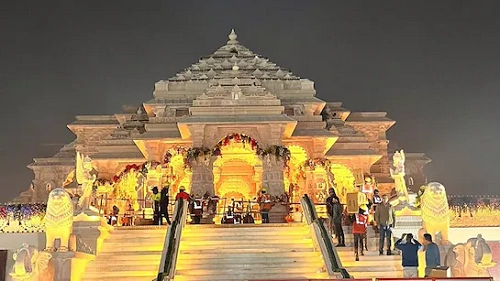
The magnificent Shri Ram Janmabhoomi Mandir located in Ayodhya is one of the most important Hindu pilgrimage sites in India. The temple marks the birthplace of Lord Rama, a central figure in the Hindu epic Ramayana.
After centuries of historical and religious significance, the grand Ram Mandir has emerged as a global spiritual landmark attracting millions of devotees every year. Since its inauguration, the temple has become one of the most visited religious destinations in India.
The temple architecture reflects traditional Nagara-style temple design, built using pink sandstone and intricate carvings that depict scenes from the Ramayana. The main sanctum houses the idol of Ram Lalla, the child form of Lord Rama.
Due to the enormous number of pilgrims visiting daily, the temple administration has implemented a structured schedule for darshan, aarti, and special rituals. Visitors must follow security rules and entry procedures to ensure a smooth pilgrimage experience.
1. Daily Ayodhya Ram Mandir Darshan Timings
The temple follows a daily schedule with a short afternoon closure.
Darshan Schedule
| Session | Opening Time | Closing Time |
| Morning Darshan | 6:30 AM | 12:00 PM |
| Afternoon Break | 12:00 PM | 2:00 PM |
| Evening Darshan | 2:00 PM | 9:30 PM |
Best Time for Darshan
The most peaceful time to visit is between 6:30 AM and 8:30 AM.
After 9:00 AM, the number of visitors increases significantly and waiting time can reach 2–3 hours.
2. Daily Aarti Schedule
Several aartis are performed every day inside the temple.
Aarti Timings
| Aarti Name | Time | Requirement |
| Mangala Aarti | 4:00 AM | Pass Required |
| Shringar Aarti | 6:15 AM | Pass Required |
| Bhog Aarti | 12:00 PM | During temple closure |
| Sandhya Aarti | 7:00 PM | Limited public entry |
| Shayan Aarti | 10:00 PM | Pass Required |
Aarti Pass Booking
To attend most aartis, devotees must obtain a pass issued by the Shri Ram Janmbhoomi Teerth Kshetra Trust.
Passes are usually limited and must be booked in advance.
3. Sugam Darshan and VIP Entry
To manage the large number of pilgrims, the temple offers different darshan systems.
Sugam Darshan
Sugam Darshan allows devotees to book a specific time slot for entry.
This service is usually free and helps reduce waiting time to around 30–60 minutes.
Aarti Passes
Aarti passes are also free but must be reserved about 10–15 days in advance through the official temple website.
Visitors must carry original identification documents such as Aadhaar or voter ID for verification.
4. History and Spiritual Importance
Ayodhya is considered one of the seven sacred cities in Hinduism.
According to ancient scriptures, this city is the birthplace of Lord Rama, the seventh incarnation of Vishnu.
The Ram Mandir stands at the exact location traditionally believed to be Ram Janmabhoomi, the birthplace of the deity.
The temple construction uses traditional techniques with no steel reinforcement and incorporates thousands of sculpted pillars, statues, and mythological carvings.
The sanctum houses the idol of Ram Lalla, which represents Lord Rama as a child.
Devotees believe that visiting the temple brings spiritual blessings and divine protection.
5. Major Festivals in 2026
Ram Navami – March 26, 2026
Ram Navami marks the birth of Lord Rama and is the most important festival in Ayodhya.
On this day, the temple hosts a special ritual called Surya Tilak, where sunlight is precisely directed onto the forehead of the Ram Lalla idol at noon.
During this festival, waiting times can reach 5–8 hours.
Diwali (Deepotsav)
Ayodhya celebrates one of the grandest Diwali festivals in India, commemorating the return of Lord Rama to Ayodhya after defeating Ravana.
Makar Sankranti and Kartik Purnima
These festivals also attract large numbers of devotees.
6. Best Time to Visit Ayodhya Ram Mandir
Ideal Season
The best time to visit Ayodhya is from October to March, when the weather is pleasant.
Best Day
Weekdays usually have shorter queues compared to weekends.
Best Time of Day
Early morning darshan between 6:30 AM and 8:30 AM offers the most comfortable experience.
7. Dress Code and Visitor Guidelines
Although there is no strict dress code, modest traditional clothing is recommended.
For Men
- Kurta-Pajama
- Dhoti
- Formal trousers and shirt
For Women
- Saree
- Salwar Kameez
- Traditional Indian attire
Prohibited Items
Visitors are not allowed to carry:
- Mobile phones
- Cameras
- Smart watches
- Leather belts
- Large bags
Free locker facilities are available near the temple entrance.
8. How to Reach Ayodhya Ram Mandir
Ayodhya is well connected by road, rail, and air.
By Air
Nearest airport: Maharishi Valmiki International Airport
Distance: about 10 km from the temple.
By Train
Nearest railway station: Ayodhya Dham Junction
Distance: around 2 km from the temple.
By Road
Ayodhya is connected to major cities such as:
- Lucknow – 135 km
- Varanasi – 200 km
- Prayagraj – 170 km
Regular buses and taxis are available.
9. Where to Stay Near Ayodhya Ram Mandir
Due to the temple’s popularity, many hotels and dharamshalas have opened in Ayodhya.
Temple Guest Houses
Pilgrims can stay in dharamshalas run by religious trusts.
Nearby Hotels
Several budget and mid-range hotels are available close to the temple area.
Luxury hotels are also emerging as Ayodhya develops into a major pilgrimage city.
FAQs
Q1. What are the darshan timings of Ram Mandir?
Ans: Morning: 6:30 AM – 12:00 PM
Evening: 2:00 PM – 9:30 PM.
Q2. Is mobile allowed inside Ram Mandir?
Ans: No, mobile phones and electronic devices are not allowed inside.
Q3. How long does darshan take?
Ans: Usually 1–3 hours, depending on the crowd.
Q4. What is the Surya Tilak ritual?
Ans: It is a special event where sunlight falls on Ram Lalla’s forehead on Ram Navami.