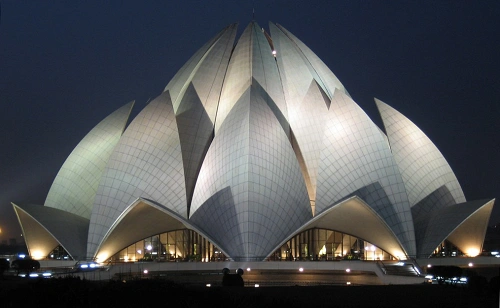
The serene Lotus Temple, officially known as the Baháʼí House of Worship, is one of New Delhi’s most iconic landmarks and among the most visited spiritual sites in the world.
Completed in 1986, this architectural masterpiece welcomes people of all religions, cultures, and beliefs. There are no idols, no rituals, and no priests here — only silence, reflection, and prayer. The temple’s striking lotus-shaped structure, built with 27 white marble “petals,” symbolizes purity and unity, concepts shared across Indian traditions and the Baháʼí faith.
Inside the prayer hall, absolute quiet is maintained. Visitors sit in calm contemplation while short readings from different world scriptures are recited at fixed hours. Entry is always free, and Mondays are reserved for maintenance — meaning the temple remains closed every Monday.
Surrounded by landscaped gardens and reflecting pools, the Lotus Temple offers a rare pause from Delhi’s fast pace, making it equally popular with spiritual seekers, tourists, photographers, and architecture lovers.
Below is a complete guide with timings, history, travel details, and practical tips.
Daily Lotus Temple Timings
Visiting hours change by season to match daylight.
| Season | Days | Opening Time | Closing Time |
| Winter (Oct – March) | Tue – Sun | 9:00 AM | 5:30 PM |
| Summer (April – Sept) | Tue – Sun | 9:00 AM | 7:00 PM |
| All Year | Monday | Closed | Closed |
Entry Cut-Off
Entry usually stops 30–45 minutes before closing so visitors already inside can complete their visit peacefully.
Prayer Services (Daily)
Short 10–15 minute sessions are held at:
- 10:00 AM
- 12:00 PM
- 3:00 PM
- 5:00 PM
These include readings from Baháʼí writings and other world scriptures, followed by silent meditation.
Lotus Temple History and Spiritual Significance
Designed by Iranian architect Fariborz Sahba, the Lotus Temple is one of eight Baháʼí Houses of Worship worldwide. Its nine-sided design reflects the Baháʼí principle of unity of religions.
Unlike traditional temples, there are:
- No images
- No sermons
- No ceremonial worship
It exists purely as a space for quiet reflection. The lotus was chosen because it holds spiritual meaning across Hinduism, Buddhism, Jainism, and Islam — reinforcing the idea that humanity shares a common spiritual root.
Today, the temple attracts millions annually and stands as one of Delhi’s most photographed monuments.
Best Time to Visit Lotus Temple
Best Season
October to March, when Delhi weather is cooler and pleasant.
Best Time of Day
- 9:00 AM – 10:00 AM: Quietest period with fewer crowds
- After 4:00 PM: Beautiful golden-hour light for exterior photography
Avoid
Weekends and public holidays (visitor count can exceed 30,000+ per day).
How to Reach Lotus Temple
By Metro – Nearest station: Kalkaji Mandir Metro Station (Violet & Magenta Lines).
From Exit Gate, it’s a clearly marked 5-minute walk.
By Road – Located near Nehru Place.
From New Delhi Railway Station, it takes about 40–50 minutes by taxi (roughly 14 km, depending on traffic).
Autos, cabs, and app taxis are easily available.
Lotus Temple Essential Rules & Visitor Tips
Silence
Absolute silence must be maintained inside the prayer hall.
Footwear
Shoes must be removed before entering the hall. Free shoe racks are provided.
Photography
- Allowed in gardens and exterior areas
- Strictly prohibited inside the prayer hall
Dress Code
No rigid uniform, but modest clothing is requested (cover shoulders and knees).
Security
- Avoid large bags
- No food or drinks inside the main complex
Carry only essentials to speed up entry checks.
Lotus Temple FAQs
Q. Is there any entry fee?
Ans: No. Entry is completely free.
Q. Can people of any religion visit?
Ans: Yes. Everyone is welcome.
Q. How long should I plan for the visit?
Ans: About 60–90 minutes including gardens and meditation hall.
Q. Is guided tour available?
Ans: Volunteers often explain the temple concept near the entrance.
Q. Is Monday always closed?
Ans: Yes, every Monday without exception.